

Jesus Shrine at an Empty Church: Defending Walter Jr.’s underdevelopment in Breaking Bad

*spoiler alert for the entire series Breaking Bad!*
“You’re about 15 years too late,” is what my partner said to me as I was mindlessly scrolling ice-white wigs on Facebook Marketplace, having just made an offhand remark about dressing as Khaleesi for Halloween. We had just finished watching The Red Wedding episode of Game of Thrones. The desire to be bleach blonde and scantily clad in fantasy cosplay aged me almost as much as the episode discussion threads on Reddit, peppered with “DAFAQ?” as a reaction to the gut-wrenching scene. As an avid live-discussion forum reader—what were they thinking when it aired?!— I am used to being a time traveler wading through murky internet waters.
Like all self-proclaimed original thinkers, I always seem to miss a show until the height of its popularity has died down. I was criminally late in marveling at the twists and turns of Lost, the glamorous world of Downton Abbey, and the cold-blooded comedy of What We Do in the Shadows. Even the Heated Rivalry craze I missed by about two months—by the time I was ready to wax endlessly about its heart-wrenching story, my friends were sick of hearing about it.
The latest and perhaps most significant of my missed calls is Vince Gilligan’s Breaking Bad, named by many as The Greatest (English language?) TV Show of All Time™.
Admittedly, I put off watching Breaking Bad because of my own prejudices. Male-centered boom-boom fantasy crime shows were never particularly my thing (notice how all the “classic” and “best ever” movies and TV shows happen to be about men and their stories?), and that is precisely what some of the show’s most notorious fans construed it to entirely be. It left a bad taste in my mouth, only for me to be humbled later by religiously watching the series every day for hours, for weeks, missing appointments and cancelling plans, peeling away its layers of symbolism with 99% purity.
Of course, popular culture made me aware of the show’s most classic elements far before I had seen the first episode. There was the ever-lovable Indiana Jones of raiding hot topic bins, Jesse Pinkman. The apparently “bitch nagging wife” car-wash empress, Skyler White (yo). And, of course, the family man of the year himself, Walter White.
But as I began to watch the show, I realized: Why did I never hear about Walt Jr.—or whom I’ll affectionately call by his chosen name, Flynn?
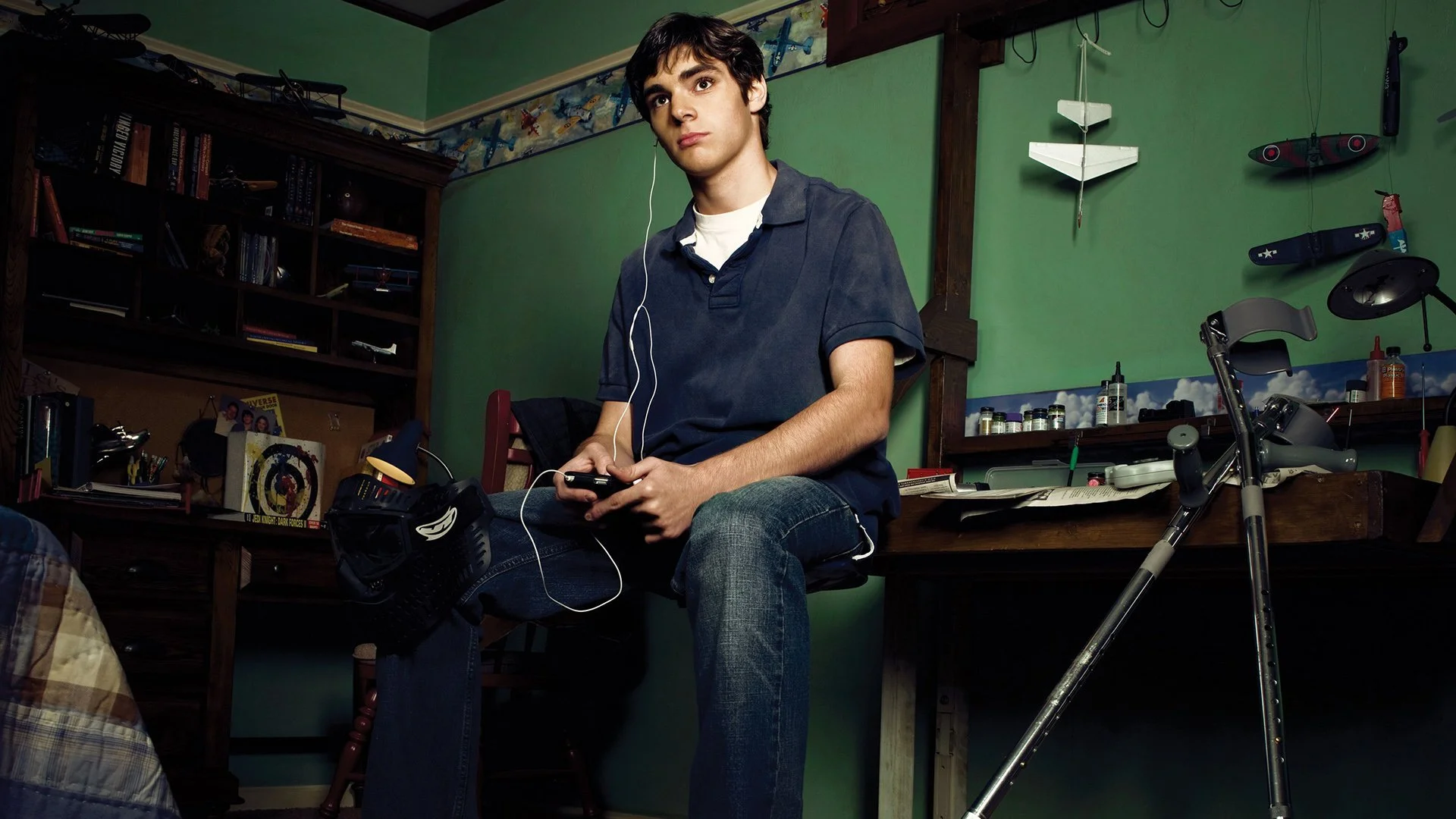
Promotional image from Breaking Bad. Photo: Frank Ockenfels/AMC; source image via Wallpaper Abyss / Alpha Coders.
Flynn’s character is equivalent to a Jesus shrine at an empty church. Everything Walt (and later, Skyler) does is supposedly in service of this character, yet we pretty much know nothing about him. We know that he has a friend named Louis, likes breakfast and walking down hallways, and is at least vaguely familiar with HTML/CSS coding. We never really learn about his dreams, his quirks, his insecurities. Flynn’s small flashes of interiority are ever-charming ("I thought we were going to Cold Stone Creamery” when taken by his uncle to a run-down meth motel), but almost instantly swallowed back into the machinery of Walt’s story. If it were not in service of something, I would sneer at writers for making this character painfully underdeveloped and badly written.
So, in the early seasons, I was annoyed. The poor kid felt tossed away and used only as a plot device, and his presence only continued to dwindle as the series went on. This was hardly undetected—fans and media critics alike have spent years trying to explain not only what the character of Flynn tells us about the story of Breaking Bad, but why a character so central to Walt’s supposed motivation is given so little screen time, development, or interior life.
One solution for this is reading Flynn’s character as an audience surrogate: the one who reminds us how we would normally react if we weren’t so sucked into the saga of the show. Under this premise, Flynn’s ambiguousness allows the audience to project themselves into his character and further emotionally invest in the story. When the Whites’ lies become too absurd to sustain, even to their tenderhearted, wide-eyed son, Flynn becomes the rare person in the room reacting with the appropriate amount of anger and confusion, dragging us back to the dirty carnage in our path. Perhaps his vague personality was a designated breath of normalcy, gifted to us by the writers, haphazardly dropped into the kitchen every few episodes to remind us of the insane stakes of it all, and not much more.
Others frame him as the central expository character of Breaking Bad. Much has been memed about Flynn’s needlessly extensive breakfast-and-cereal-related dialogue, but I suppose the repetitive, subdued setting of family breakfast does serve a purpose: it gives the show a stable arena where transforming family dynamics can finally come to light. In this view, Flynn’s breakfast scenes function as domestic status checks: is the family still vaguely intact? Who is on good terms? Who knows what? Where are we in this grand unraveling?
There’s merit to both readings and, if true, Flynn was a great way for the Breaking Bad writers to avoid the god-awful “as you know...” dialogue so often used in screenwriting in 2026, where every showrunner seems terrified you are second-screening under the covers. In both characterizations, Flynn’s flatness is not a flaw but a utility—a way to drag the audience back from the billowing fumes of Walt’s Hannah Montana double life.
I think both readings are basically true, but neither fully explains why Flynn has to remain so ambiguous. A character can function as an audience surrogate or an expository mechanism and still be pictured as having a rich inner life. However, the characterization of Flynn I disagree with completely was also the one I encountered most often (at least according to the 14-year-old WordPress blogs and slop YouTube videos I combed to write this essay): Flynn as “the moral center of the show”.
“Walt Jr.’s character represents Jesus,” reads an Instagram comment with 431 likes. Breaking Bad, like all popular media that deals in good, evil, sacrifice, and punishment, cannot escape being read through the lens of religious allegory. Flynn becomes our heavenly innocent: the manipulated bystander who atones through his horror when the truth finally reaches him. My problem with this isn’t that there aren’t religious themes in Breaking Bad (“shall I give my first-born for my transgression, the fruit of my body for the sin of my soul?” - Micah 6:7), but that many of these readings name Flynn as the virtuous example in the show while also paradoxically admitting we know almost nothing about him—a Jesus shrine in an empty church.
Why give Flynn a narrative authority the show itself rarely grants him? In fact, I think the writers purposely give him moments of moral greyness to complicate this theory. If Flynn is supposed to be the moral center of the show, a squeaky-clean foil to Walt’s evil, why have him side with his obviously wrong father for most of the series? Why show him so often enthralled by his uncle’s grandiose, drunken tales of DEA violence? If Flynn is the moral center, why does the show treat the interior life that produced this morality as an afterthought?
Flynn is not a saintly, Jesus-like truth-teller floating above the wreckage of his family. He is a normal teenager with limited information, which means he is often confused, unfair, reactive, and wrong. I love Flynn for his sweet-as-pie sarcasm and unreasonably long eyelashes, but calling him the moral compass almost overdevelops him in a way that is not backed by the flat writing of the show. To call him this means turning him into a symbol of innocence instead of a whole person—which is, ironically, what Walt does too, leading their relationship to eventual demise.
Other fans simply accept this flatness as one of the weak points of the show. They argue that, as the disabled son of a drug-dealing protagonist who teaches at the very high school Flynn attends, there was much more to be desired from his storyline (a valid frustration–imagine a Breaking Bad from Flynn’s perspective). Maybe the writers did just neglect him. But as time went on, I realized that Flynn’s obvious lack of character depth and development compared to others in the series may as well be intentional. And by season two, I designated it as one of the best subtle narrative directions made on the show.
The decision to sidestep ol’ Junior’s humanness—through limited screen time, generally little character development, and an absence of interior life—attempts to subtly spell out, across five seasons, what the show finally says clearly in its final episode: Walt’s family-man alibi was hollow from the very beginning.
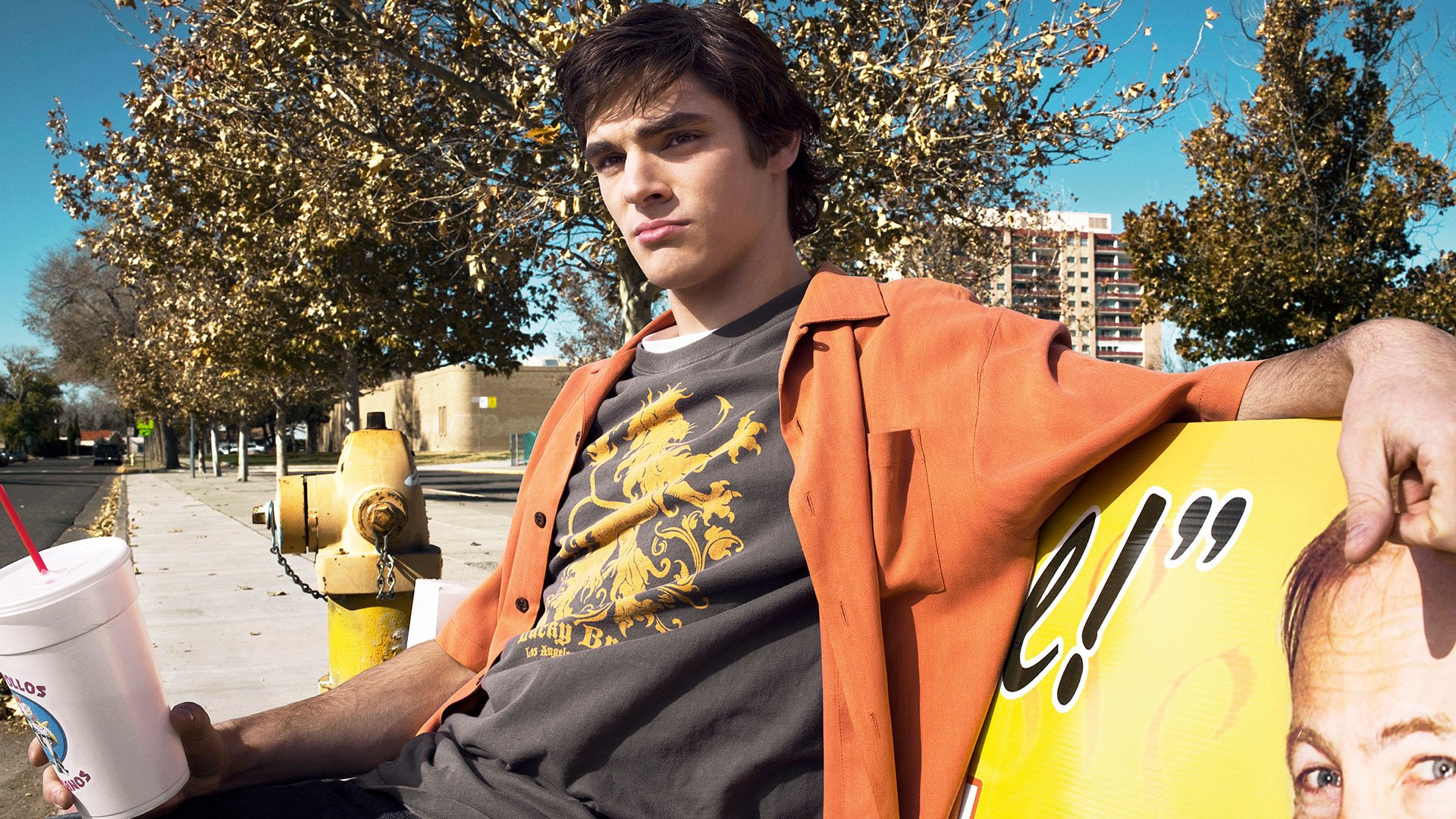
Promotional cast portrait from Breaking Bad Season 4. Photo: Ben Leuner/AMC; source image via Wallpaper Abyss / Alpha Coders.
Flynn is the litmus test to this alibi, the clue-of-all-clues to the outcome of the tragedy, and that only works because he is underdeveloped. His character serves three main functions, each one building on the last. First, because we can interpret the show as organized through Walt’s self-mythology—Vince Gilligan later admitted that Breaking Bad was “rigged,” with its storytelling “solely through Walt’s eyes, even in scenes he wasn’t present for”¹—Flynn’s limited presence becomes on-screen proof of how little actual father-son intimacy exists beneath Walt’s supposed sacrifice. We don’t know his son because Walt doesn’t know his son. His limited screen time is not a lapse in editorial judgement, but exposure of the flimsy relationship at the center of Walt’s family-man story.
Second, because Flynn is kept at such a narrative distance, Walt and the audience can more easily use him as a blank canvas on which to project and confirm Walt’s idealized conception of fatherhood. Critical writing on Breaking Bad often treats Walt’s masculinity as something anxiously staged through the family, where fatherhood is a performance in need of witnesses. Therefore, in a show so obsessively structured around Walt’s wounded self-image, Flynn becomes both an object of projection and a means of revealing the insecurities that drive Walt’s endless performance of self.
His vague characterization completes the show’s almost Hegelian exploration of identity: you are no one if your desired self-image is not recognized by others, and Walt craves more than anything to be recognized as powerful by those around him. Only a son kept at a distance can become the perfect empty canvas for Walt’s ideal self-image: provider, protector, martyr, man of the house—all the performances of fatherhood, the final boss-level realm in which Walt is so desperate to amass respect.
And finally, because the audience is kept at Walt’s distance too, the show makes us temporarily complicit in the abstraction. Walter White’s family-man alibi is both the narrative backbone and emotional pull of the series. What pulls Breaking Bad beyond your typical crime fantasy is the building up, then subsequent shattering, of the fantasy that Walter White was just a decent man in bad circumstances. “Doing it for the family” is par for the course in these sorts of dramas, just human enough to be low-hanging fruit for the masses. However, in Breaking Bad, Flynn’s ambiguousness causes us to feel the emotional, abstract force of “family” before we are forced to confront the thinness of the actual father-son relationship itself.
If Flynn were granted too much interior life too early, Walt’s sacrifice fantasy would have to answer to an actual son, not the abstract family he keeps invoking to excuse himself. This is why the story would not be the same if Flynn were more developed: Walt’s family-man lie would collapse much earlier, leaving far less room for viewers to root for Walter White and then look back, bashful and guilty, at how badly they wanted him to win.
Flynn is not “empty” because the writers forgot to fill him in; he is “empty” because Walt’s idea of “family” is emptier. What results in “Felina” is the shattered image of The Family Man: the fool who shortchanged intimacy with his son for a taste of 1950s-esque masculine pride, only to be left in the ashes with distinctly nothing.
Now, this is all obvious by the end of the show, and yes, the show is called Breaking Bad because Walter is bad. Given that it’s been 15 years and that this is one of the most popular shows of all time, I doubt I’m the first person to arrive at this conclusion (sweating and holding a “Walt was the villain?” sign). Nevertheless, Walt’s hand-waving away of his various crimes for the higher, sanctimonious purpose of “family” remains prevailing evidence, to many fans, of the moral greyness of his character. To this day, there are still thousands of fans, old and new, participating in endless discussions about when Walt “truly” broke bad—was it the death of Jane? Poisoning a child? Some later atrocity in a beige jacket and fuck-ass hat?
What inspired me to write this, all these years later, is that while fans keep scrambling to locate the exact behavior that finally disproves Walt’s family-man story, Flynn’s serial underdevelopment is still so often treated as separate from that debate, rather than a direct answer to it.
To make sense of this, I want to turn to the scenes where Flynn’s limited characterization helps dramatize Walt’s catastrophic downfall, the series’ principal narrative interest. So far, I have been talking about Flynn’s broader narrative function: how his limited presence exposes the flimsy relationship at the center of Walt’s family-man alibi, and how his ambiguity makes the audience complicit in that abstraction. Now, I want to focus on the second function: how Walt uses Flynn as a blank canvas for his idealized conception of fatherhood. Across the series, their scenes together repeatedly turn Flynn into a test of Walt’s self-image.
Flynn’s underwrittenness serves three overlapping roles in Walt’s fantasy of fatherhood: proof of lineage, captive audience to masculine performance, and dependent child who justifies the provider fantasy. By the end, Flynn also breaks each of these fantasies, completing the narrative arc of the show. These scenes show that, while Walt’s relationship with Flynn is not completely devoid of love, it is fatally crowded by the story Walt so desperately needs fatherhood to tell about him.
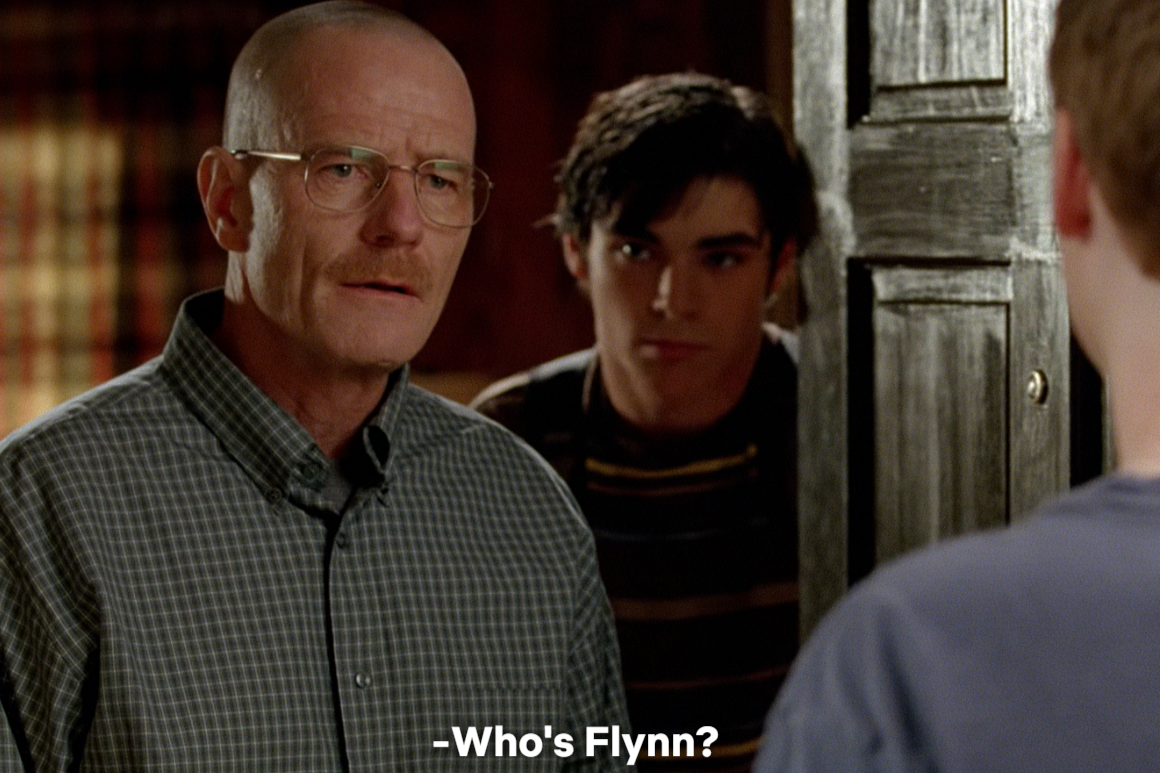
Breaking Bad, “Over” (S2E4), Netflix, 00:17:42. Screenshot by author.
Fatherhood as Proof of Lineage
The first and most obvious projection is right there in the name: Walter Jr–Disgustingly on the nose and straight to the point. It became painfully obvious in Breaking Bad that Walt struggles with treating Flynn as something beyond an extension of himself. The little screen-time RJ Mitte is dedicated to shaking this flawed projection.
In “Down,” Walt desperately tries to return to the role of “good family man” after the nonsense Tuco disappearance, already failing to notice what has changed at home—including the fact that his son has started going by a new name. Flynn’s departure from Walt’s namesake is introduced through bestie Louis, not through Flynn himself. Walt immediately turns to Skyler and says, “What’s wrong with Walter Jr.?”
Flynn’s self-actualization is read by Walt as a threat to his masculine authority and paternal legacy: Skyler explains, “He wants his own identity.” Walt, in his typically embarrassing fashion, speedruns any of the concerns a normal parent may have when a child spontaneously chooses a new name for themselves, and immediately blurts out “You think he told Louis about me?” (referring to his fugue state nude escapade). It is an almost perfect Walt reaction: Flynn’s attempt at self-definition is instantly rerouted into anxiety over Walt’s own image.
Throughout the entire show, Walt never actually asks why Flynn chose this new name. Flynn’s attempt at separateness is treated by Walt as information about himself, and his waning authority over his own family life, instead of something about his son.
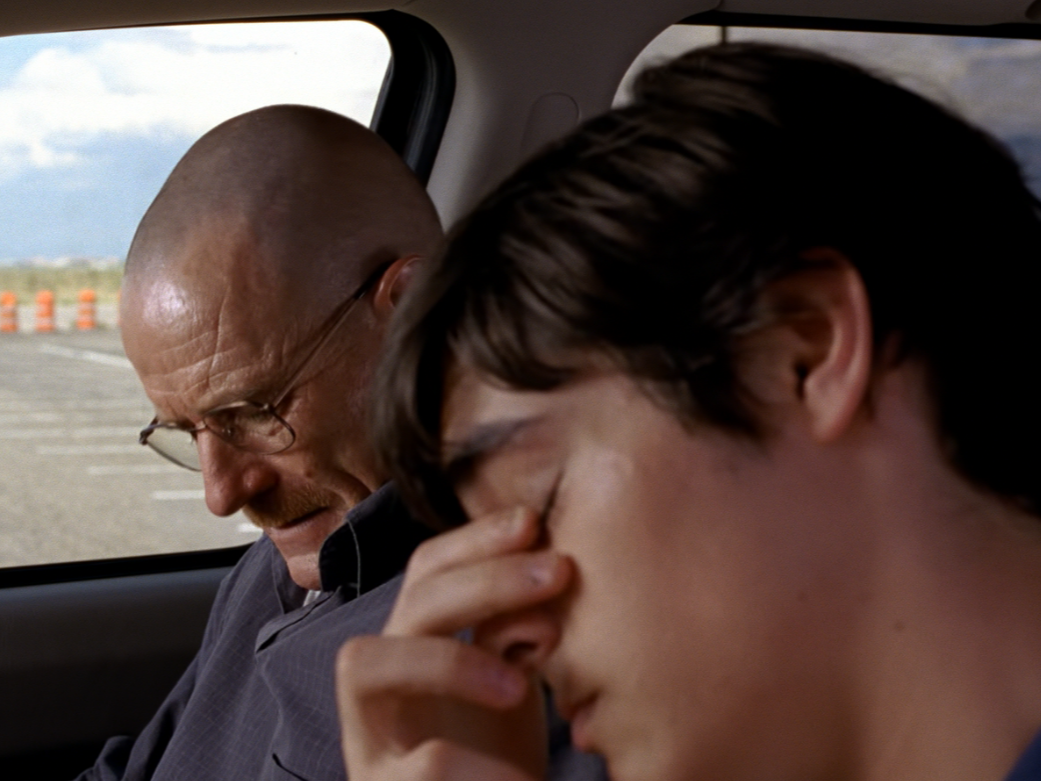
Breaking Bad, “Over” (S2E4), Netflix, 00:31:51. Screenshot by author.
This pattern continues in the very same episode, “Down,” during the painfully awkward father-son driving lesson, where we hear for the first time the absolutely iconic and horrendously ironic Walter White quote: “There’s the easy way, and there’s the right way.”
I never wanted to bitch-slap Walter White more than when he motivational speech’d his son into driving in a way that is not possible for him. Flynn is in the driver’s seat, using both feet on the pedals. Walt, of course, cannot leave it alone. Flynn says, “I can’t do this. My legs don’t work that way.” In a cartoonishly evil fashion, Walt answers “Your legs are fine. You just have to stick with it. Don’t set limits for yourself, Walt.” Girl, My God.
The show has been praised for not making Flynn’s cerebral palsy the entirety of his character (a sentiment I echo), nonetheless; it is difficult not to read this scene as a particularly nasty implication that Walt subconsciously sees the “able-bodied” way as the only right way, and struggles to meet his disabled son in his own reality. His sour advice almost kills his son; his indifference is testament to how routinely Walt disregards his son’s own agency, even denying him expertise on his own body. After the inevitable crash (because “the right way” is not actually right for Flynn), Walt calls him “Walt,” and Flynn assertively answers, “Flynn.”
Deserved! I found myself cheering every time Flynn refused satisfaction to his quasi-deadbeat father. This denial of his son’s agency comes back later in “Sunset,” when Walt tries to reframe his upcoming divorce with Skyler as a new opportunity for father-son closeness: now, apparently, Flynn will see much more of him because Walt can drive him to and from school. Flynn does not buy it: “It’s not like I get a vote,” he says, before cutting through Walt’s optimism with brutal teenage sarcasm: “What? I gotta stop going with Louis just because you’re feeling guilty?” The show did most of the grunt work of Flynn’s character arc in these moments, aptly placed in the tug-of-war between Walt seeing his son as a whole person and needing him to remain a symbol of his own legacy.
To walk a few steps backwards, Flynn’s disability deserves a fuller analysis than I can responsibly give it in this essay. I do not want to reduce it to a device for understanding Walt. But because the show does not make Flynn’s cerebral palsy the entirety of his character, the moments where his disability does come into focus carry more interpretive weight: Walt pushes him, dismisses his limits, or answers his humiliation with violence. Through these carefully chosen scenes, we can infer that Walt is ableist (among many other ists). Not in the garden-variety cruelty way, necessarily, but informed by Walt’s own relationship to weakness, limitation, and control—ignited by his desire for Flynn to exist as an extension of his idealized self.
At the beginning of the show, Walt hates himself for his meekness. He is a man blood-red with resentment about his own choices, and that inadvertently seeps into how he treats his son. RJ Mitte, the actor who played Flynn (who also has cerebral palsy in real life), has spoken about how disability is so often read by others as weakness, saying that “when you have a disability, people think you are weak. They think they can prey on you.”²
Has Walt adopted the same perspective? Not consciously, probably. Walt would never place himself among those bullies, but the driving scene (among other denials of his son’s agency) hints that he may very well share their frustration for his son’s perceived limitations. This is also why so many viewers come away feeling that Walt has a more intimate relationship with Jesse than with his own son (a favorite topic for Breaking Bad essayists).
RJ Mitte himself basically points toward this reading, saying that because of Flynn’s cerebral palsy, “there’s a lot of things that Walt couldn’t do with his son that he can do with Jesse,” and that Jesse becomes a “surrogate son” Walt can use “for his will”³. Getting back to the point, in these scenes, Flynn’s uniqueness from his father—his chosen name and specific way of moving through the world—becomes something Walt cannot tolerate, because he objectifies his son as being an extension of himself. Flynn does not need a fully developed subplot for the pattern to become clear; his small assertions of separateness are enough to make Walt’s projection visible.
Breaking Bad, “Pilot” (S1E01), Netflix, 00:39:12. Screenshot by author.
Fatherhood as an Arena for Masculine Performance
The second function of Flynn’s character is to act as a captive audience to Walt’s masculine performance. Walt is tangled up in the traditional, boringly almost universal grammar of hegemonic masculinity: force, control, authority, respect. Flynn’s character is positioned close enough to witness this flawed performance, but distant enough that the storyline remains centered on Walt’s transformation.
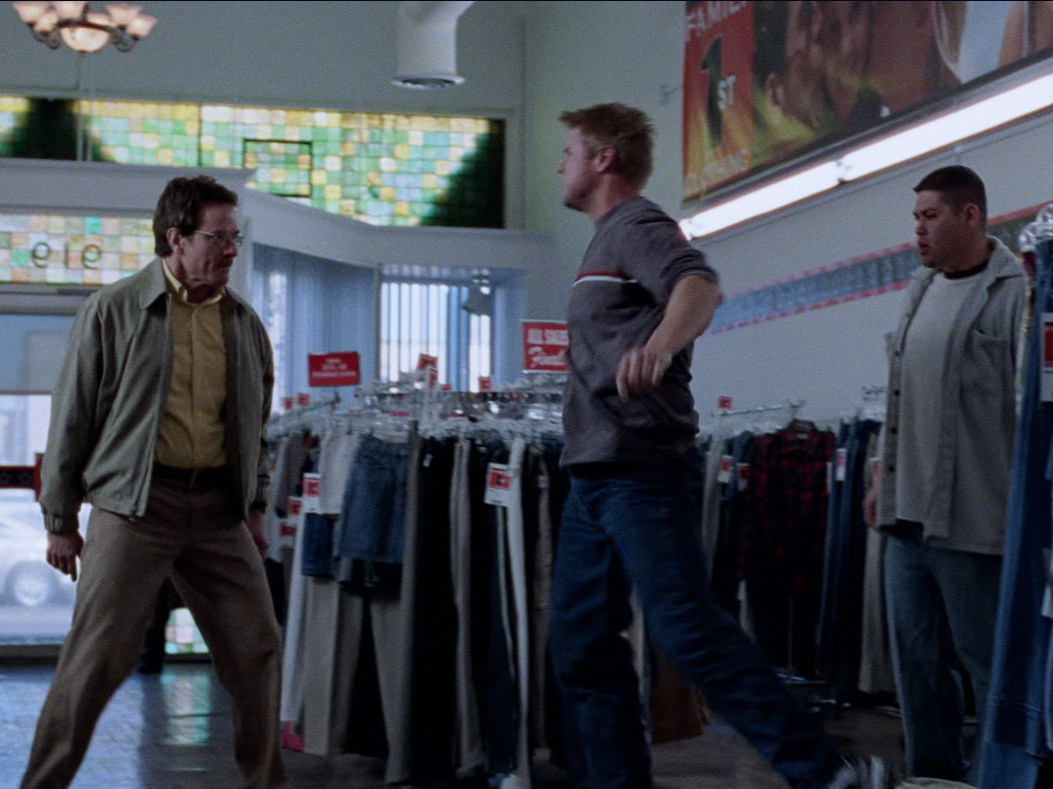
The first delicious taste of power we watch Walt experience is not conspicuously producing meth, but beating up one of Flynn’s bullies in the very first episode. When Flynn is mocked by his high-school classmates for his disability, Walt does not comfort him but beats the bully down and throws the insult back in his face: “Having a little trouble walking?”
It is one of those lines that sounds triumphant for half a second, until you realize Walt is defending his disabled son by making his exact disability the insult (bringing us back to the aforementioned ableist theme). The scene is crucial to the wider logic of the show: it is the first time we see Walt “successfully” use violence as an affirmation of self and fatherhood, only to spiral gloriously thereafter. He answers the humiliation of Flynn’s body by humiliating another body in the same terms. What feels like paternal protection is already compromised: Flynn’s pain becomes the occasion for Walt to experience himself as powerful.
Breaking Bad, “Over” (S2E10), Netflix, 00:12:52. Screenshot by author.
Furthermore, it is, of course, impossible to mention “masculinity as a performance” without mentioning the fatherly authority love triangle made up of Walt, Hank, and Flynn. If fatherhood is one of Walt’s main arenas for performing masculinity, then Flynn becomes both the audience and—crucially—a judge. The bully scene allows Walt to imagine himself as the triumphant protector, but numerous scenes with Hank humiliate that performance by showing that Flynn’s admiration is not automatically his to claim.
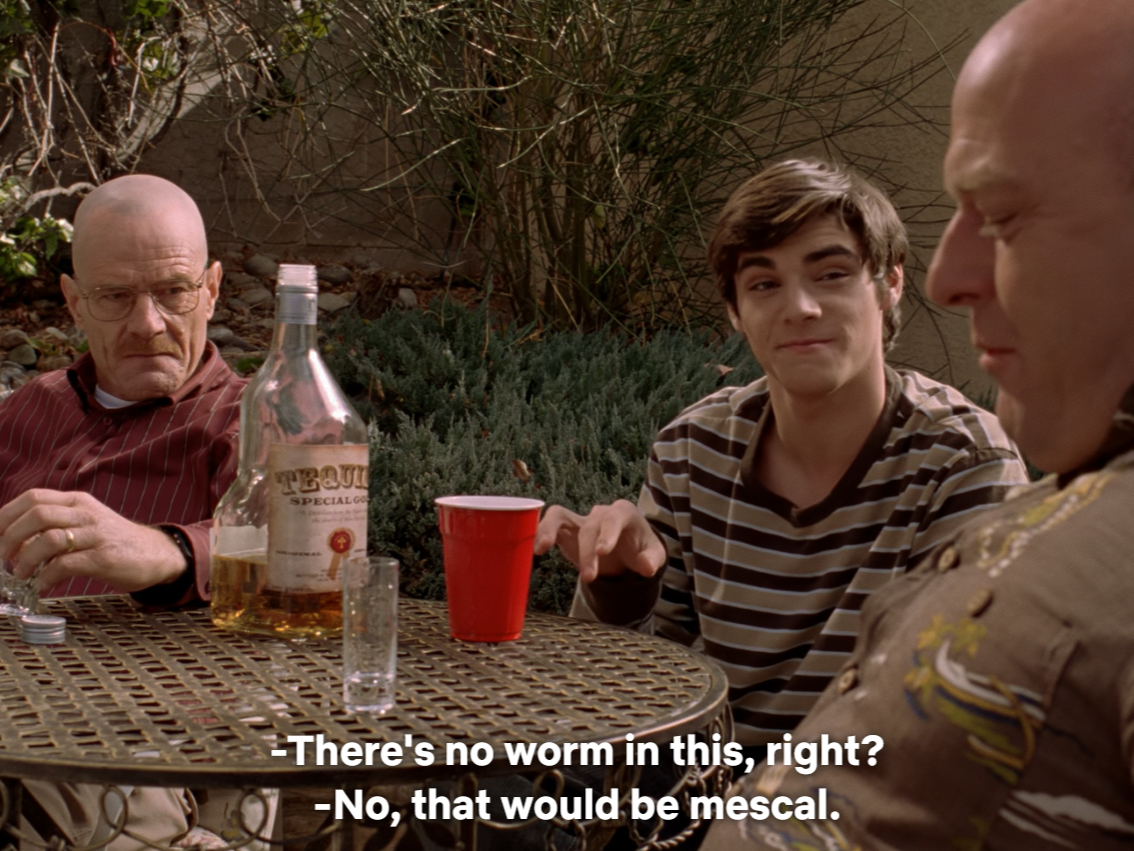
Hank is everything Walt resents and envies: loud, crude, physically confident, professionally violent, and somehow still beloved in the White home. Fans have pointed out that, as inadequate and ridiculously racist as Hank can be, he often functions as a better male role model to Walt Jr. than Walt does himself, making the dynamic even more humiliating for Walt. In perhaps one of the most devastating of early episodes, “Over,” Walt forces Flynn to inhale shots of tequila in a white male boomer masculinity contest that he did not ask to be in.
Walt’s jealousy of Hank is palpable, and Flynn is cleverly positioned as a wedge sitting between them. The scene is staged around watching: Flynn watches Hank’s drunken DEA storytelling, Walt watches Flynn watching Hank, and then Walt tries to yank that admiration back toward himself. So he keeps pouring tequila. When Flynn looks to Hank for permission, Walt snaps, “What are you looking at him for?” and when Hank finally intervenes, Walt gives his possessive inclination away: “My son. My bottle. My house.”
The scene ends with Flynn vomiting into the water, strengthening the recurring motif of the contaminated pool. Fans have theorized that the glimmering suburban waters represent Walt’s outward need to present a clean image of domesticity, even as they are dirtied by moments of moral failure (he obsessively fishes impurities out of them). Here, Flynn’s vomit in the pool literalizes Walt’s masculine performance poisoning the family well. The next morning, Walt grovels in embarrassment—it is one of the few genuinely tender moments between them where he attempts to claim accountability for his bad behavior.
But devastatingly, Flynn mutters: “But I kept up, right? I drank three?” There, the face-drop of a century occurs, because his son has mimicked the shallow masculine performance right back at him. Walt has not taught Flynn that he crossed a line; he has taught him that the point was to endure it. Instead of following that horror anywhere meaningful, Walt says “okay,” leaves the room, and retreats into housework: buzzing around with tools, rot, and repairs, as he cannot sit with what he has just broken in his son.
Recalling the driving lesson scene from earlier, cars (one of Flynn’s few actual stated interests) are the frequent setting for rehearsals of masculine self-image among several characters. The pathetic Aztek belongs to pre-Heisenberg Walt: meek, emasculated, stuck in the life he resents. By the Chrysler/Challenger era, Walt is trying to buy a more powerful masculine image outright, and Flynn becomes the audience he gets to share it with.
The show even gives him a pathetic bourgeois funhouse mirror in Ted Beneke, another man who dresses bad decisions in the language of family responsibility. Ted insists he cooked the books to keep the company alive and protect people, then, when handed a lifeline, somehow ends up with a leased Mercedes. A parallel of a parallel of a parallel.
By the time the infamous Challenger montages set to dubstep arrive in the fifth season, this same dynamic has become shinier and emptier, as Flynn’s actual personality gradually disappears from the show. Walt does not need Flynn to say much, or to know him deeply. Masculinity, as all performances of identity, is something that requires an audience. Flynn’s function is to make Walt’s performance of flawed masculinity legible to both himself and the audience.
Breaking Bad, “Phoenix” (S2E12), Netflix, 00:19:50. Screenshot by author.
Fatherhood as Provision instead of Intimacy
In my humble childless opinion, Walter’s family-man alibi started being complete bullshit the second he turned down the well-paid Grey Matter job out of pride. Vince Gilligan echoed the sentiment: Walt was “thrown a lifeline” early on, and a better person would have swallowed his pride and taken the help–that was the fifth episode. It’s a smart move that establishes early on that Walt does not really want his family provided for; he, specifically, wants to be the provider.
Thus, bringing us to the final function of our beloved lover of breakfast: The Beneficiary. He is the imagined recipient of Walt’s financial sacrifice: the empty figure who gives the family-man alibi its initial moral cover and eventual destruction.
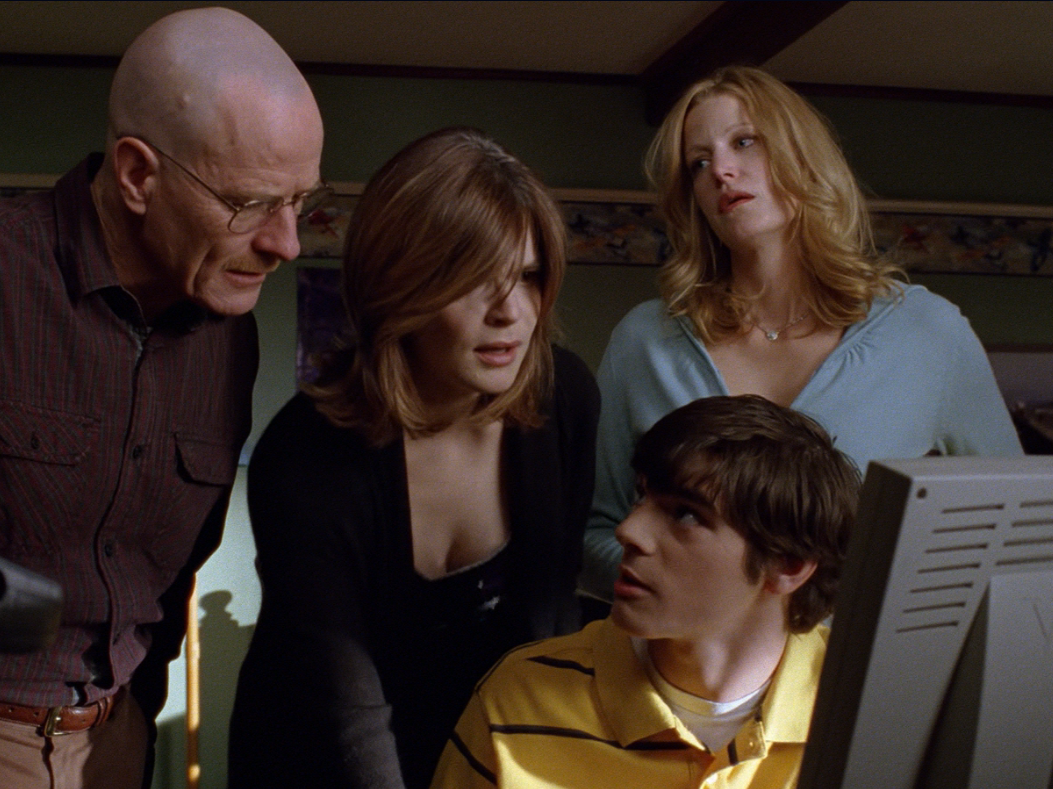
This unbelievably basic patriarchal bedtime story sets the scene for Walt’s grand humiliation: savewalterwhite.com. Wonderfully maximalist and dripping with nostalgia from the ‘aughts, I found it really funny that this webpage is one of the few things we see Flynn do on his own accord in the show (and of course, it is still related to his father).
In the episode “Phoenix,” after publishing a website intended to seek donations for Walt’s cancer treatment, the White family (to Walt’s horror) ends up on daytime TV. I adore this episode because the audience is told explicitly what Flynn values about his father–he opens the news segment talking about how his father is his absolute hero, an “all around decent guy” because of how much his students and family love and value him–the webpage features similarly intimate thoughts. It should be one of the most moving things Flynn ever does for Walt, and he fucking hates it. With his tail between his legs, he runs to Saul Goodman and complains that it’s like he’s “rattling a tin cup to the entire world” and “cyber-begging”. The website does exactly what Walt claims he wants: it helps the family. Afraid to be pitied and obsessed only with money, Walter White clearly cannot accept love that makes him visibly dependent.
Breaking Bad, “Ozymandias” (S5E14), Netflix, 00:37:05. Screenshot by author.
“So I guess if you’re gonna buy me off, buy me off,” Flynn jokes in season 4, while pointing to a Dodge Challenger. Of course, Walt cannot buy him off. And this all becomes clear in the final few episodes of the show, where fatherhood through provision is the only form of identity Walt has left in his relationship with his son.
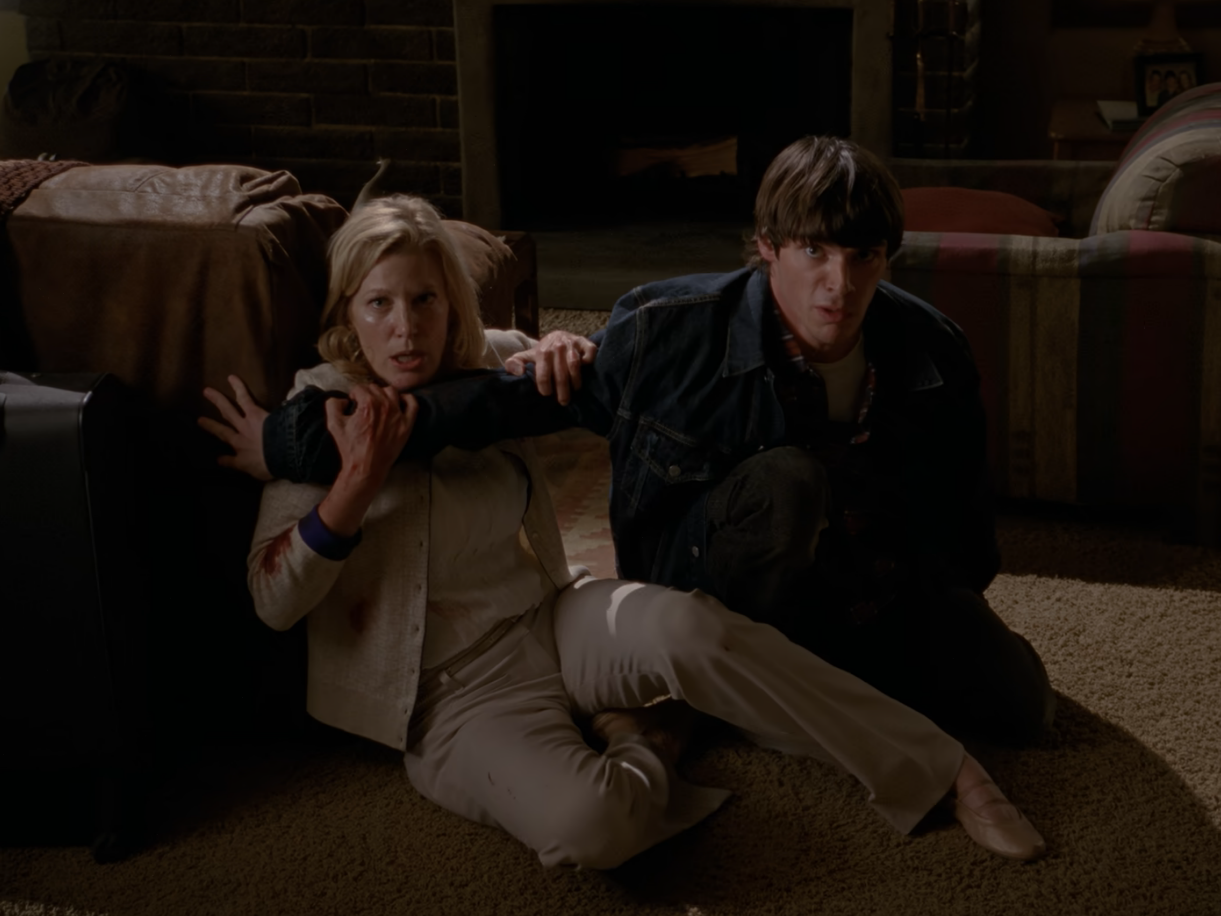
By “Ozymandias,” Walt’s provider fantasy has been violently severed from the family it was supposed to justify. The domestic sphere is no longer the sentimental backdrop against which Heisenberg can be rationalized. Walt bursts into the house with the same dead-eyed insistence that has carried him through every catastrophe: everything can still be fixed if everyone just obeys him quickly enough! But for the first real time in the show, Flynn is no longer positioned as Walt’s namesake, audience, or beneficiary: he’s in on the big secret too. And the second he knows, the whole structure collapses with humiliating speed. When Walt screams “We’re a family!” it lands as the final exposure of the phrase’s emptiness. The word family, which Walt has spent five seasons treating as an abstract moral credit account, is returned to the gruesome, trembling bodies in the room. A son defending his mother from his own father.
“Granite State,” the penultimate episode, is a formal completion of the show’s critique of patriarchal fatherhood. Vince Gilligan describes Walt as having spent years “looking through the wrong end of the telescope,” believing that making his family financially secure was “all he has to do as a man, as a provider, and as a father.”⁴ Walt calls Flynn from exile not to offer accountability but to route money back into the family through yet another humiliating workaround. Even now, fatherhood appears to him as a logistical problem to solve, one which is answered with Flynn’s succinct “Why don’t you just die already?”.
In that sense, Flynn’s minor character arc does what no confession from Walt could do on its own. Skyler receives the truth—”I did it for me”—but for those with keen eyes, Flynn’s narrative distance makes the alibi narratively unusable from the very first season. Walt’s final patriarchal gesture—secretly leaving his son blood money he has already said he wants absolutely nothing to do with—is crucially still one of arrogance and deception.
Every objectification of Flynn that Walt needed to sustain his ego (namesake, witness, beneficiary) has failed him. As soon as Flynn has some semblance of personality and agency, the show is complete. It breaks the last fantasy Walt has left: that provision can retroactively redeem the absence of intimacy. Five seasons of empire-building come to their pathetic end, round the decay of that colossal wreck, boundless and bare…the lone and level sands stretch far away.
***
So that is it, right? All of the thousands of philosophical and psychological scholarly articles and think-pieces written to this day, the reason my friends would respond to me, mouths agape, flying hands to their heart—“You haven’t seen it?” Watching Breaking Bad was my first flirt with overcoming my prejudice for the classics, and I can’t say I’m disappointed. I hope you enjoyed reading my extremely long essay. Flynn sums everything up more beautifully than I can during a conversation with Walt at the hospital, as Hank recovers from the cartel assassination attempt.
Flynn: Everybody knows who Pablo Escobar is, but nobody knows about the guys that brought him down.
Walter White: I guess I never thought about it like that.
Flynn: He said that good guys never get ink like the bad guys do.
All screenshots are from Breaking Bad, created by Vince Gilligan, originally aired on AMC, accessed via Netflix. Used here for critical commentary.
Sacks, Mike. 2022. “Vince Gilligan Wants to Write a Good Guy.” The New Yorker. August 21, 2022. https://www.newyorker.com/culture/the-new-yorker-interview/vince-gilligan-wants-to-write-a-good-guy?
Khaleeli, Homa. 2015. “RJ Mitte: ‘Nothing I Do Will Ever Compare with Breaking Bad.’” The Guardian. Guardian News and Media. January 7, 2015. https://www.theguardian.com/tv-and-radio/2015/jan/07/rj-mitte-walt-jr-nothing-compare-to-breaking-bad-cerebal-palsy.
Watkins, Gwynne. 2013. “The Breaking Bad Gq+a: RJ Mitte on Walt Jr.’s Dad Issues and Trying to Avoid Spoilers.” GQ. GQ. September 6, 2013. https://www.gq.com/story/the-breaking-bad-gqa-rj-mitte-on-walt-jrs-dad-issues-and-trying-to-avoid-spoilers.
Snierson, Dan. 2022. “Breaking Bad”: Creator Vince Gilligan Explains Series Finale”. https://ew.com/article/2013/09/30/breaking-bad-finale-vince-gilligan/.