

Spring Snow
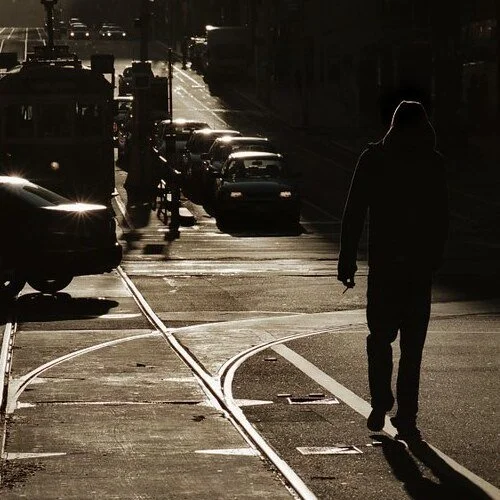
Wednesday evening.
Slouched deep into one of the bright orange terrace chairs, with a hard-earned closing beer in one hand and a cigarette slowly burning itself out in the other, I watched pale leaves drift through the air in a kind of quiet trance. Every time a tram thundered past, they rose again in sudden spirals, caught inside invisible gusts of wind that only became visible through their movement, like the exaggerated dust clouds in old western cartoons whenever a cowboy disappeared over the horizon at full gallop.
Most real Amsterdammers, or at least the city’s weathered veterans, seemed to regard the growing piles of blossom gathering along terrace edges and in doorways with mild irritation. Amsterdam’s annual spring epidemic. Something to sweep away, complain about, shake from your jacket sleeves before stepping inside. And maybe, given enough years, the city would sand away the charm for me too. But for now, it still felt beautiful. Earlier that week, a friend of mine had jokingly called it spring snow, and watching the pale blossoms drift weightlessly through the evening light, I realised there wasn’t really a better way to describe it. Freshly liberated from my work shirt and back inside the familiar disguise of my own clothes, I sank deeper into the chair. My shift had finally ended, but the relief barely lasted a moment before the weight of everything still waiting for me settled back in.
So I stretched the beer out in tiny sips, delaying the inevitable moment I’d have to stand up and make my way home, where an entire waiting list of chores, unanswered messages and half-finished responsibilities sat patiently waiting for me. Every extra minute on that terrace felt like stolen time.
However, I had almost forgotten that the universe has a habit of throwing perfectly timed nonsense distractions in my direction whenever responsibility starts approaching too closely. And almost right on cue, my excuse arrived. At the far end of the terrace, a guy began moving from table to table, stopping briefly at each one to sell poetry. He looked exactly the way someone wandering from terrace to terrace selling poetry ought to look: a worn shoulder bag hanging from one side, wind-tangled hair, and a gaze that seemed both completely absent and intensely attentive at the same time. Slightly chaotic, slightly fragile, slightly vague, yet entirely absorbed in what he was doing. I recognised him almost immediately.
About a year earlier (or at least close enough to a year for me to romanticise it that way) I had met him here too, on this exact same terrace. Back then, I had just half-applied for the bar job I now worked at. It was the day after King’s Day, I remember that much for certain; the kind of hungover misery that permanently burns itself into memory. That night, slightly drunk and filled with misplaced enthusiasm, I had bought one of his poems on impulse. Or at least, that is the version of the story my blurry memory has preserved. Somewhere between the terrace and my walk home, I lost the poem itself. So seeing him again now felt strangely cinematic, like the universe offering me a second chance, or, more realistically, like my procrastination demons disguising avoidance as destiny and handing me one final excuse not to go home yet.
Before he could disappear into the next café, I pulled out my notebook and hurriedly began underlining empty pages with half-formed sentences, hoping I could still transform vague intentions into something worthy of trading.
Unfortunately, like most hyperfixation-fuelled distraction manoeuvres, the idea collapsed almost immediately under its own ambition. I had started, as I often do, completely obsessed with the aesthetic of an idea while having absolutely no clue what the idea itself was actually about. No structure, no direction, just the vague fantasy of a finished product floating somewhere far ahead of me. Still, the pressure of time became part of the process. I kept scribbling half-formed sentences while watching him slowly drift from table to table across the terrace. Just as he was about to leave, I scratched out the final line and stopped him mid-step. “Would you want to trade a poem for a poem?”
Ik twijfel en ik gris,
Ik zoek en mis.
Ik streep en ik kras, ik scheur en ik schrap,
en ergens vergeet ik dat de schrijver vóór het verhaal was.
Als een kip zonder ei
kan ik mijn kop nergens kwijt,
want wat kwam eerst
de kip of het ei?
En wie schrijft hier wie?
Wie leidt,
en wie leidt mij?
Ben ik het die schrijft,
of schrijft het verhaal mij?
Misschien is schrijven daarom
geen vangen van taal,
maar dwalen en zoeken
naar bestaansrecht tussen papier en verhaal.
Als het steen dat wandelt onder de voeten van de stad,
is mijn verhaal versleten:
vergankelijk en vertrapt.
Woorden verbleken
zoals voetsporen verdwijnen in regen,
vervagen en vergaan,
tot de bladzijden van mijn schrift
slechts spreken van schoenen,
vergeten stappen,
van komen
en gaan.
His reaction carried about the exact level of enthusiasm you would expect from someone who had made being broody and mysterious part of their full-time profession. Meanwhile, I sat there vibrating with the barely contained energy of a seven-year-old presenting a science project to deeply unwilling parents. As he read, I found myself wondering whether I had once again mistaken politeness for genuine interest. Whether the faint smile on his face belonged to a genuinely moved reader or merely the exhausted patience of a primary school teacher enduring yet another overexcited presentation held together entirely by glitter glue and confidence.
When he finally looked up, his expression remained almost impossible to read, much like the sincerity behind the soft, or perhaps simply polite, compliments that followed. Then he asked whether he could fold the page, and with an almost ceremonial level of care for what was objectively just a crumpled sheet hastily torn from my notebook, he carefully slipped it into the folder hanging from his shoulder. Afterwards, he lit a cigarette and disappeared into the kind of thoughtful silence that looked almost painful. Desperate to receive my own poem, yet suddenly uncertain about the social etiquette surrounding poetic barter, I defaulted to asking him about his life instead.
He told me he made money selling poems across cafés and terraces throughout the city. Over time, he had mapped out routes for himself, selecting places based on the likelihood of finding potential poetry buyers. The poems themselves were not improvised on the spot but printed beforehand and carried around inside the worn folder hanging from his shoulder. Sometimes he asked people what they liked — films, art, music, certain kinds of poetry — and other times he simply chose based on vibes alone.
Sadly, that is about as much as I can reliably tell you about him. Fragments remain: that he lived partly in Amsterdam and partly in Lille, that he was currently bike-less, which in Amsterdam feels less like an inconvenience and more like a mild social disability, and that next week he had a job interview at Gamma (a small but sobering reminder of the financial reality lurking beneath artistic ambition).
Most of the conversation itself, however, dissolved almost immediately afterwards. Partly because I was tired, partly because I was still too preoccupied wondering whether he had genuinely liked my poem to properly listen, but mostly because the conversation itself never really moved in straight lines. It wasn’t awkward exactly, nor entirely coherent either. The sentences drifted between us like loose strands of smoke rather than building into anything solid.
In hindsight, the conversation resembled the look in his eyes. There was something strangely heavy in the pauses between his sentences, in the way his thoughts seemed to arrive a little later than his words. His gaze felt both entirely absent and overwhelmingly intense at the same time, like someone permanently staring both through the world and too deeply into it.
The exchange never really moved forward so much as drifted sideways through silences, cigarettes and passing trams.
Eventually, somewhere between another pause and the sound of a tram rattling through the street behind us, I found a way back into the conversation.
“So… which poem would you choose for me?”
For a moment, he quietly rummaged through the overstuffed folder hanging from his shoulder, thoughtfully scanning loose pages and folded printouts as though trying to find the version of me that best matched one of them.
Eventually, he pulled out a single sheet and handed it to me.
“This one,” he said.
Verlangen
David Meijers
Mar 22, 2026
Geef me de nacht. Vertel me wat je wilt. Laat me, een andere keer, je slaaf zijn, stuur me van hot naar her, breng me naar boksles in een kinderzitje, met een speen in mijn mond.
Laat aan mij de eiwitten, de overweldigende kracht van het lichaam, het samenspel tussen membraanprocessen en onbegrijpelijke cognitie. Leef mee met mijn wereld, met de samenhang die vol met waarheid nog niet in m’n uitingen past, waardoor ik iets aan het missen ben dat steeds bij me is, zoals wanneer je een geliefd liedje in je hoofd hebt. Leg me uit waar jij voor leeft, als je dat kunt, luister naar wat mij elke dag bezighoudt.
Maak me veilig, schud me door elkaar als een cocktail, ik stem Partij voor de Dieren. Wanneer ik aan Optiver denk, weet ik nu dat ik de kracht, die ik niet kwijt wil, aan een ander geef. Jij hoeft me niet te helpen met dat anders doen. Maak me jouw hobbelpaard, ik wil dat jouw kut op mijn ruggengraat lekt.
Er zijn genoeg praktische kanten: ik voel die druk elke dag. Als ik ben klaargekomen, in mijn eentje, duw ik mijn voeten tegen elkaar, de ontspanning, als inkt in water, van mijn borstkas, het gevoel van de randen van mijn voeten die elkaar raken.
Er is meer kracht dan alleen die wonderen van het lichaam. Laat me je overmannen. Zoals een foto sfeer kan hebben en een verhaal en ik niet. Bestaat mijn leven? Ja.
Onder andere waar het leven wonderen ontvlucht voor een wonder dat mij persoonlijk aangaat. Verander niet, of verander door te veranderen. Maar laat me, misschien, alles in mijn hoofd, ook dat gaat me aan.
Well… tja. How do I put this.
I wish I could accurately reproduce the exact thoughts that first passed through my head while reading his poem. I can’t recall the precise sentences anymore, but I can still reconstruct the emotional landscape they left behind: somewhere between fascination, confusion, mild discomfort and the very specific form of intellectual intimidation usually reserved for difficult philosophers assigned during history class.
The kind where you instinctively feel that something important is being said, something deeply sincere, painfully human, maybe even brilliant, but your brain cannot yet fully access the frequency on which it is transmitting. While, at the same time, another part of you quietly wonders whether it might also just be an impressive amount of beautifully packaged nonsense. By the time I reached the final sentence, I realised I genuinely had no idea what I was supposed to think or feel anymore. Parts of the poem I sincerely admired. Other parts made me want to briefly leave my own body and observe the conversation from a safer emotional distance. So instead, I sat there rereading certain passages while trying very hard to maintain the facial expression of someone calmly and intellectually processing contemporary poetry, rather than someone internally short-circuiting at phrases like “maak me jouw hobbelpaard.”
And don’t get me wrong. As someone who spent a significant portion of her teenage years on Wattpad, I can appreciate a good piece of smut or, let’s be honest, even badly written smut if the circumstances are right. But beyond the initial shock value, a second wave of confusion quickly followed:
Why had he chosen this specific poem for me?
Before I had fully gathered the words for whatever response my brain was trying to assemble, a third voice suddenly interrupted the silence by asking him for a poem of their own, pulling him away towards another table almost immediately. And on the way home, somewhere between rereading the poem beneath passing streetlights and mentally replaying the conversation for the fiftieth time, I kept circling back to the same questions. Had my enthusiasm accidentally come across as flirting? No… surely not. Or was that simply the kind of energy I apparently gave off without realising it? Or maybe (and this remained both the most likely explanation and somehow also the one that sounded most self-invented), I had simply interpreted his poem entirely wrong.
Which means that maybe (and I say maybe because I am still figuring out the exact moral of this story myself while writing it) this was never really about the poems themselves.
Not their literary quality. Not whether mine was actually good. Not whether his entirely made sense to me. Not even whether either of us correctly understood the other at all.
And if I am being honest, part of me probably also just wanted an excuse to indulge in yet another unnecessary hyperfixation. To spend an entire evening obsessively rewriting sentences instead of dealing with the countless more urgent things waiting for me at home. There is undeniably something slightly performative about transforming a random terrace interaction into an existential poetry exchange, but let’s not unpack that too deeply right now.
Because in the end, it was never the actual contents of the poems that mattered most. Not the carefully arranged metaphors, meanings or beautifully constructed sentences. What mattered was the existence of the poems at all.
The poem not merely as text, but as artefact. As social object. A temporary permission slip for human connection. Two strangers briefly using pieces of paper to justify speaking to one another.
And maybe that is what stayed with me most about that Wednesday evening. Not the poem I wrote. Not even the poem he gave me. But the brief interruption poetry created inside ordinary life. The temporary suspension of routine, responsibility and isolation. Two slightly lost people meeting somewhere between performance, loneliness, cigarettes and passing trams. So next time you are sitting outside somewhere, stretching out the final sip of your drink before finally going home, maybe look up from your screen for a moment.
You might catch some poetry passing by.