

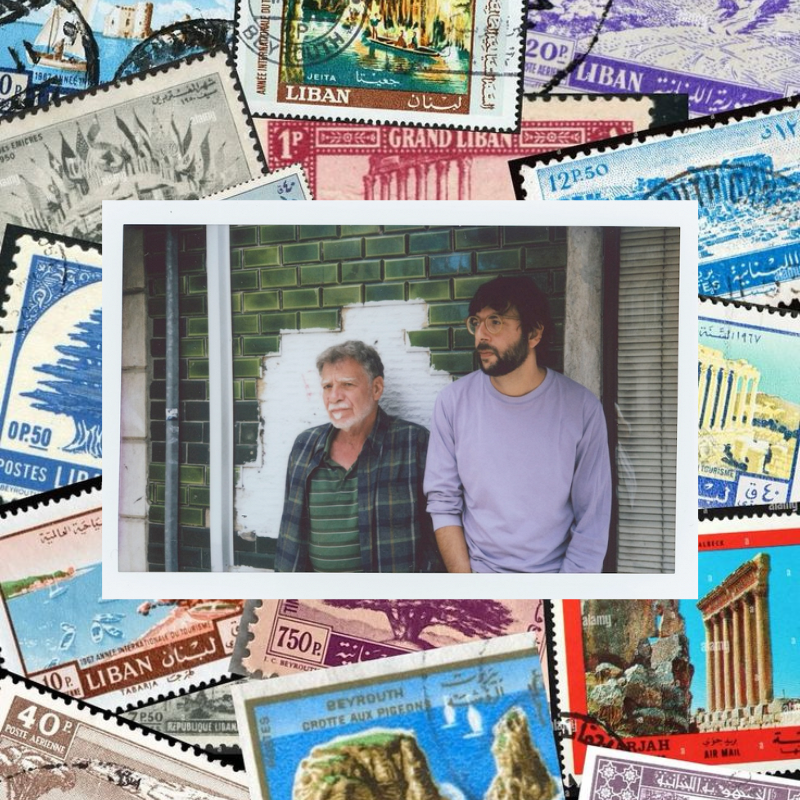
Over the course of the past few years, I have come to know an important name of the contemporary music scene, one you are most likely already familiar with: Habibi Funk, the independent record label based in Berlin, Germany, which regularly reissues music from the Arab world in curated compilations. The label aims to bring forgotten works from the 60s, 70s, and 80s back into the international spotlight and to ensure credit and visibility for the artists they collaborate with, who often have seen their art be obscured by circumstances of war, exile, or hardship. Its founder, Jannis Stürtz, who has explicitly distanced the label’s mission from Western narratives of white saviorism or from generalized perspectives on the versatile Arab world it aims to honor, has nonetheless played an important role in allowing the recognition of several artists’ rightful legacies.
With that in mind, I would like to present to you two musicians who, within the last year, have collaborated with Habibi Funk by each releasing compilations of their work, old and new. While both hail from Lebanon, they represent different generations, different ideas, and different ways of making music. Their projects with Habibi Funk have garnered significant acclaim, so much so that they recently joined forces by embarking on a European tour backed up by HF. If you are familiar with the label, you may already have heard their names, but whether you have or you haven’t, I invite you to read anyway.
*
Rogér Fakhr is a singer, songwriter, guitarist, and producer from Beirut, Lebanon. While active in the city’s vibrant music scene of the 60s and 70s, he left the country after the beginning of the civil war and was subsequently left out of Lebanon’s recognized musical heritage. His albums Fine Anyway (2021) and East of Any Place (2023), released through Habibi Funk, allowed Rogér’s oeuvre to finally enjoy the recognition it deserves by compiling the most significant tracks of his career into cohesive bodies of work.
Nicknamed the ‘Paris of the Middle East,’ the Beirut of the 60s and early 70s was a rich, booming hub for music and culture, hosting an international network of artists, intellectuals, and musicians who spoke French, Arabic, and English. It is here that a young Rogér Fakhr first started to play guitar and discovered his earliest influences in the work of Bob Dylan and the folk genre. He began to live on the road after running away from home at the age of 17, learning how to play from the people he would meet in camping grounds and cities all across Lebanon.
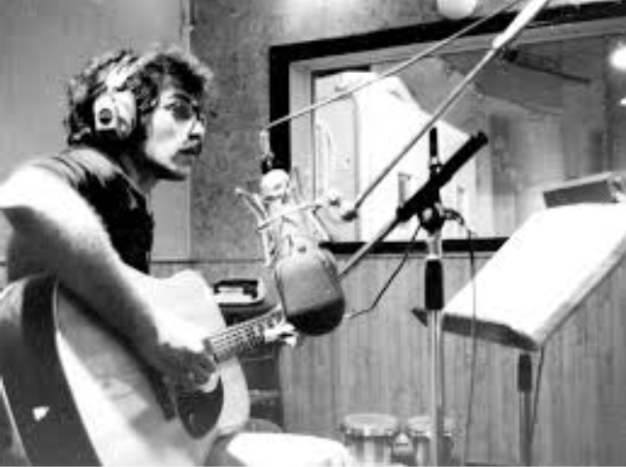
The civil war changed everything. In a 2021 interview, Rogér details the effects that the conflict had on Lebanon’s cosmopolitan art scene, interrupting the work of musicians like him who were just starting to come up. As he was periodically forced to stay in Paris to avoid the peaks of violence in his home country, his musical influences grew into a wide array of genres, from blues to jazz, soul, and rock.
Despite his lifelong commitment to the craft and the respect he earned for his contribution to the folk scene in pre-war Lebanon, most of his work did not truly see the light before his recent collaboration with Habibi Funk. The album Fine Anyway was initially released in 1977 on only about 200 cassettes, which were distributed among family and friends. When Habibi Funk approached Rogér offering to rerelease it, the musician did not feel that the album’s tracks were polished or long enough, insisting that he had to work on them more and that they were too folk-oriented to revisit. The German label instead maintained that their raw, unrefined quality reflected the true spirit of the 70s and its do-it-yourself, unembellished nature. After three years of back and forth, the Lebanese singer finally agreed to the re-release of the album after his collaboration on a fundraising project for the bombing of Beirut’s port garnered significant appreciation.
Released in 2021, Fine Anyway is a collection of songs recorded during different time periods and places in Rogér Fakhr’s life. The first tracks date back to his years in Lebanon, when he won a televised competition as a singer-songwriter and began to travel across the country. The following songs were instead recorded during his time in Paris. As an album, it exemplifies the significance of being on the road for the musician’s creative process, of collecting influences and inspirations from the cities and people he came across and reworking them into a deeply personal and introspective body of work. Genre-wise, it verges on psychedelic or acid folk, with tinges of country, rock, blues, soul, and even pop. As it is sung in English, it is not obvious that the album originates from Lebanon, and to the untrained ear (mine), it could be just one more folk project out of the US or UK. But there are hints that give away the context in which it was created: the track Sitting in the Sun, for example, features a type of improvised Arabic melody called maqam, while the song Keep Going includes verses in Arabic and builds to a crescendo of sirens and gunfire sounds, nodding to the soundscape of the incessant bombing around Lebanon at the time.
Fine Anyway works together moments from Rogér’s life that span over countries, years, genres, and ideas. The pictures that the songs paint are not, however, separate from each other but rather part of a larger image, one where the tracks join in on the meaning of the album’s title itself. To be ‘fine anyway’ means to accept that things happen to you and you just have to keep going, he explains. Sometimes hardships do not interrupt your life but rather become part of it, and it is up to you to decide whether to live with the pain or not.
I’m fine anyway.
I don’t need you to stay.
I don’t want you to go away from me.
It doesn’t matter at all if I’m blind.
I can see through the night, in a way.
East of Any Place followed in 2023 after the success of the first compilation. The album has been described as a more explicit archive of the social and political turmoil that the artist witnessed in his youth, with its Middle Eastern influences especially noticeable in the first half of the tracks. Similarly to the previous collection of long-forgotten gems, the album does not shy away from significant genre experimentation, revealing jazz, soul, and funk influences that complement its acoustic folk base. Rogér’s collaboration with the German label has now earned him over 300k loyal Spotify listeners and has allowed him to come back to the stage this year after over forty years of absence, selling out his first shows in London and Lisbon. He is currently touring Europe with another one of Habibi Funk’s powerhouse names: Charif Megarbane.
*
Charif Megarbane is a Lebanese composer, producer, and multi-instrumentalist musician. Using a variety of different monikers and pseudonyms (such as ‘Cosmic Analogue Ensemble,’ ‘Heroes & Villains,’ or ‘Monumental Detail’), he has constellated his incredibly prolific career of two decades with over one hundred albums, most of which have been released under his own label, Hisstology. He is known for combining his Lebanese and Mediterranean heritage together with the language of library music—soundscores specifically created for film, television, or radio—into a signature style that he has dubbed ‘Lebrary.’ His collaboration with Habibi Funk started in 2023, with the release of the 17-track Marzipan, the label’s first fully contemporary release as well as one of the artist’s first publications under his own name. The album was followed in 2024 by Hamra/Red and this year by Hawalat. The foundation of his own label was informed by the need to create an independent space in which to follow the founding principle behind his entire career: pure artistic creation, born out of instinct, not theory. A ‘music lab’ of sorts, a digital territory for free, unbridled musical experimentation. Here, his many projects can coexist without too much need to distinguish between them, serving rather as an archive of his own artistic evolution. His mostly analogue creative process, with its autodidactic, DIY ethos, aims to maintain the integrity of the songs by avoiding post-production editing.
The term "library music" refers to background sound scores made specifically for television or cinema and can include anything from experimental jazz, calypso, psychedelic rock, bossa nova, or even electronic music. The Italian school of the 60s and 70s is particularly well known for its contributions, thanks to avant-garde composers such as Ennio Morricone, Alessandro Alessandroni, Piero Umiliani, Piero Piccioni, and Armando Trovajoli, to name a few. These soundtracks could accompany all sorts of films, from documentaries to sleazy sex comedies, and were taken rather seriously at the time. On a personal note, I first came across library music as I started to get into the more obscure Italian B-movies from the 60s and 70s (how niche of me!). Titles like Radley Metzger’s Camille 2000 or Piero Schivazappa’s Femina Ridens (both erotic movies, both released in 1969—ha!) opened me up to a world of airy, jazzy psychedelica, which I still have not stepped away from. While I knew that library music was certainly not as overlooked as I first assumed, I did not expect for it to be able to influence the work of a contemporary artist the way that it influences Charif Megarbane’s. In a recent interview, the Lebanese musician details his first encounters with library music—going through his father’s collection of obscure film titles—and traces a shared Mediterranean sensibility between his home country and Italy. This connection, he explains, was severed with the outbreak of the civil war in Lebanon as its borders shut down and its regional exchanges with the other Mediterranean countries were cut off. Charif’s work, then, is all the more important today, building a much-needed bridge across Mediterranean regions. One that I would be happy to cross.
It would be ambitious, or better yet, impossible, to attempt an overview of Charif’s immense body of work. Spanning across decades, names, labels, and genres, he has come to be recognized as surely one of the most prolific contemporary artists I have ever had the fortune of discovering. I can, however, attempt an introduction to the albums he has recently put out through Habibi Funk. Marzipan, released in 2023, includes 17 instrumental tracks through which the artist evokes the soundscapes of the bustling Beirut, the cheerful Lebanese countryside, or the luscious Mediterranean beaches. But while this first project looks at Lebanon from the outside, the following Hawalat looks at it from the inside, he explains. By grouping together previous work, the album reworks Mediterranean influences, jazz, hip-hop, and even orchestral elements into an intimate dreamscape. Described as his first project to be consciously about Lebanon, its title refers to an informal money transfer system present in places where relying on traditional bank exchanges is not an option. By exploring themes of diaspora, exile, and of the ‘networks that keep people moving,’ the album’s geographical influences (such as Lebanon, Naples, and West Africa) fuse with the legacy of European cinema music to describe artistic and economic exchanges across cultures, generations, and places.
Tucked in between these two acclaimed releases there is a third one: Hamra/Red, published in 2024, and it just so happens to be my favorite. It is meant to be the first one in a collection of playful instrumental albums loosely attached to the idea of a color or place; in this case, not only the color red, but also Beirut’s famous Hamra neighborhood. In the style of hip-hop beat tapes, it includes tracks such as Pesce Rosso (‘goldfish,’ innocent and darting), Stella Marina (‘starfish,’ impudent and snarky), or the upbeat, flutey Coccinelle (‘ladybugs’). It is snappy and contagiously guileless, and it clearly draws inspiration from the experimental sounds of 60s and 70s film sound scores, making it an immediate hit for me.
Last week, I had the pleasure of catching Charif and his band play live at BIRD in Rotterdam. While Roger did not sadly join the musician on this stop of his European tour (is something wrong with Rotterdam?! Probably), I can nevertheless say with confidence that it was one of the best live shows I have ever attended. And not only because I was familiar with his music and knew that it would perform well live; the band’s stage presence was simply phenomenal, and the overall atmosphere of the show was intimate in a way that allowed me to take in the music better than I would have had the crowd been bigger. Charif and his band were playing instruments that I had never even seen: an electric guitar with a small lever attached to it, which would make those glittery vibrating sounds I now recognize as one of the artist’s signatures, or one of the band members’ little piano sets, which had a tube attached and would produce dreamy, 60s-style beats when blown into. I later looked them up and discovered that while the former is called a whammy bar (or tremolo), the latter is a melodica (a type of harmonica); but in the moment, those instruments resembled magical objects, and their players magicians. Casting their funky spell over the audience, the band delivered a selection of tracks mostly taken from the musician’s collaborations with Habibi Funk. As Charif played, his entire body moved in a jittery fashion—head bobs, feet stomps, and wrist flicks—as he enthusiastically followed the music, grinning along with the band. At some point, he even jumped off the stage and made his way through an ecstatic crowd (the parting of the Red Sea!), all the while still playing his guitar/mystical artifact. And as the band performed an experimental, guitar-heavy rendition of Fred Buscaglione’s Love in Portofino (a musical postcard of 50’s Italy and another personal favorite), I decided I was glad to have taken a bus and two trains to come to Rotterdam on a Sunday evening in November.
*
Rogér Fakhr and Charif Megarbane trace stories of exile, diaspora, and cultural migration, weaving their Lebanese heritage into a wider network of international musical traditions across decades and geographies. If you happen to be in Germany, Spain, or Portugal this December, you might still be able to catch them live. And if you’re not, don’t worry: just press play.

Sources
https://busybeesplaylist.ca/2025/04/22/roger-fakhr-a-master-storyteller/
https://www.enharmonicmagazine.com/post/deep-dive-the-lost-tapes-of-rog%C3%A9r-fakhr
https://testpressing.org/magazine/fine-anywayan-interview-with-roger-fakhr
https://www.middleeasteye.net/discover/lebanon-roger-fakhr-music-fine-anyway-album
https://www.passionweiss.com/2018/08/27/charif-megarbane-el-condor-aparece/