

The Sea Always Follows
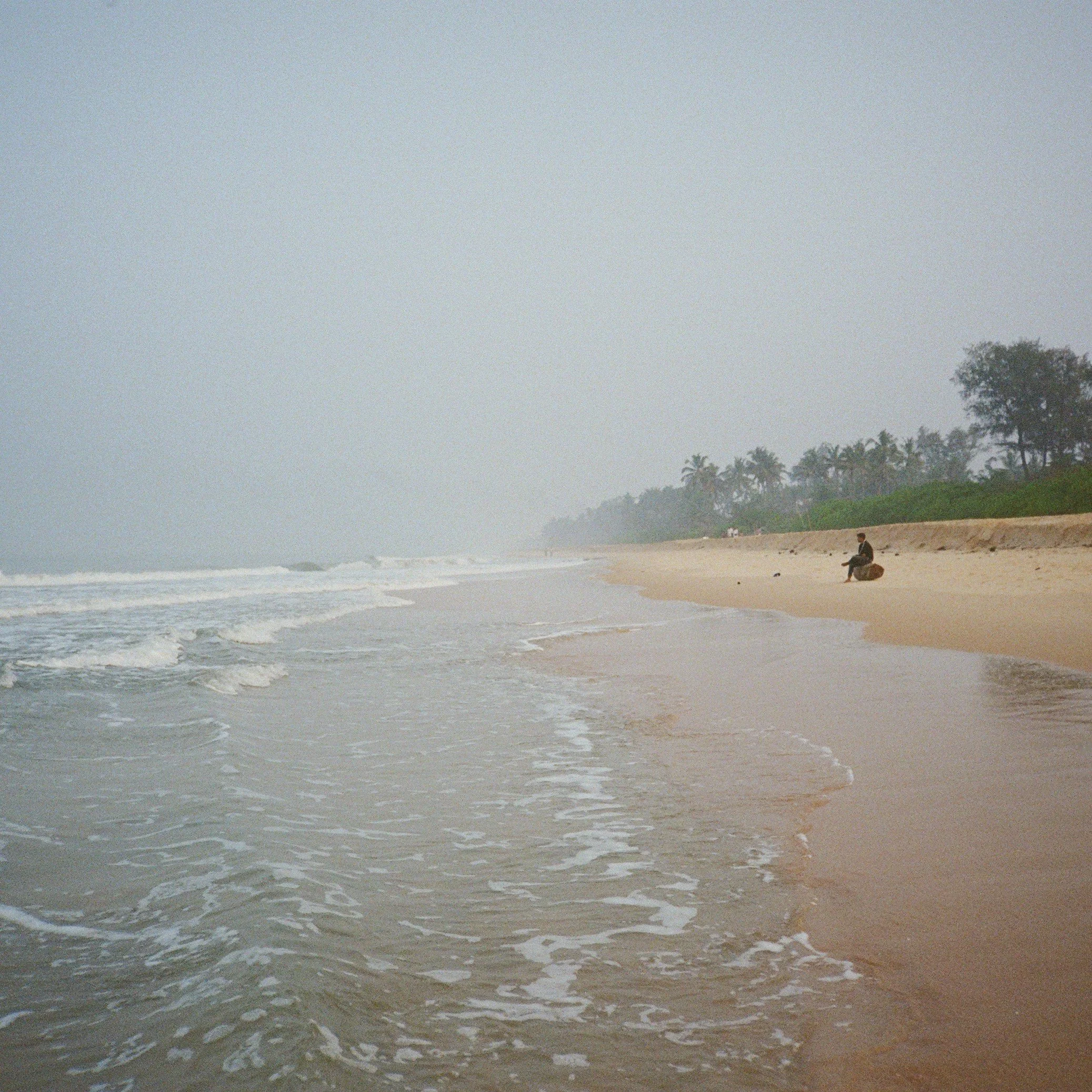
Photo by Lauri Alasalmi
As I stand on the foreshore of the Arabian Sea, the afternoon tide flowing over my ankles and hastily retracting, I remember a thing an old teacher of mine said some ten years ago, on a different shore thousands of kilometers away. “The sea always waits”. She was someone who grew up by the sea, as am – to some extent – I, so it was clear to me what she meant by that. The sea, to her, was something she felt she could always return to. Something fixed in space and time, so beautifully permanent. Home.
I look around. A bit further into the sea, my Finnish partner and our two Indian friends are taking photos of the horizon on their phones and film cameras, pant legs wet from the salty water, their lively conversation getting lost in the crashing of waves. I remember something else then, too: that all the seas in the world are interconnected, neatly flowing into the same five merged oceans.
Chapter One: Stars Hollow
Home: such a simple, yet elusive word. For a long time, I wished that I had one house, one neighborhood, or one city – anything, really, as long as it’s just one – that could contain its definition. I felt this longing build up in me year after year ever since I was just a child, but it wasn’t until quite recently, when I saw Gilmore Girls for the first time, that I was finally able to articulate it.
As I watched this cult TV series, I couldn’t help but feel a twinge of envy towards its two main characters, a young single mother Lorelai and her teenage daughter Rory, whose home fits neatly within one geographical location: Stars Hollow. This fictional Connecticut town is much more than a simple backdrop to the relationship between Lorelai and Rory, or their romantic, academic and professional challenges; it is almost a character of its own. The sets of locations that the protagonists frequent every day, such as the white gazebo of the town square, Luke’s Diner with its mismatched chairs and tables, or the endearingly chaotic Kim’s Antiques shop, give Stars Hollow a distinct and iconic visual identity. What truly brings it to life, however, are its inhabitants – a host of quirky characters whose interactions with Lorelai and Rory, as well as each other, establish Stars Hollow as a close-knit community. It is a community that gives itself an identity rooted in whimsical seasonal traditions, a community which solves its silly problems collectively by means of town meetings, in which everyone is involved in each other's lives, even if that involvement often veers into gossip.
This community is precisely what makes Stars Hollow not just a place, but a home to Lorelai and Rory, and one does not integrate into such a community overnight. It is explicitly established in the series that Rory has lived in Stars Hollow her entire life, and Lorelai – who only moved there soon after Rory’s birth – had lived there for her entire adult life too, as she was only fifteen when Rory was born. Even after Rory moves to New Haven for university halfway through the show, she returns to Stars Hollow frequently, and the town does not lose any of its narrative importance. There is no doubt that Stars Hollow is, and always will be, Lorelai and Rory’s one and only home. One geographical point to which they belong and can always return to, one community cultivated over many years. A place that always waits, just like my teacher said of the sea. I wish I could have that kind of place in my life, but it seems I was not so lucky.
For the past twenty-four years, my life has flowed from one house to another, from city to city, from country to country. I was born in Russia, where I was constantly passed back and forth between Moscow and my grandparents’ town until my parents decided to trade in the gloomy commie blocks and neverending sleety winters for sunshine and sea breeze, and moved us to Zadar, a lovely small city on the Croatian coast, when I was seven years old. Then, when I turned fourteen, we left the Adriatic Sea and all its emerald beauty behind to chase the jobs and the schools that Zagreb, the capital, had to offer. As soon as I was done with high school, I left my family and friends behind and moved to Amsterdam for university, with which I am now done – and anticipating an opportunity that would, once again, summon me to go someplace else. Family memorabilia got passed from one moving box to another, neighbors’ phone numbers were written down only to be lost later on; even most friendships came and went, like expired lease agreements. None of my homes ever possessed the stable permanence of Stars Hollow, no matter how attached to them I grew. Every home, every community I have ever had, seemed to fade away as the time mercilessly marched on, replaced by a new location and a new set of people that came with it.
Chapter Two: Globalization
Judging by the huge success that Gilmore Girls has achieved, I am not nearly the only person living such an anchorless, transitory life. Since its first air on The WB in 2000, the show has acquired a loyal fanbase of millions of viewers; at one point, it was even the network’s second-most-watched show. Sure enough, this success has a lot to do with the show’s witty writing, nuanced portrayal of generational trauma, good casting and other such formal things, but it is still undeniable that the setting of Stars Hollow and its whimsical, cozy feel, play a large part in it. I saw a Reddit post once where the author argued that, even if there was a Gilmore Girls episode with a completely uninteresting plot, they would still watch it for nothing else other than Stars Hollow, and numerous commenters seemed to agree with them. Even the show’s creator, Amy Sherman Palladino, said that what inspired her was a visit to a real-life small town in Connecticut where she felt a sense of connectedness and community: something she felt was missing from her own life.
But where did it all go wrong, why do so many of us feel like we lack a permanent home akin to Stars Hollow in our lives? There are, arguably, many phenomena and issues that this could be blamed on, but the one that I would dare call the main culprit is definitely globalization. This process of increasing interconnectedness of countries – their economies, cultures, digital landscapes – can be traced as far back in time as the ages of the silk roads and spice trades, but it only truly boomed in the latter half of the 20th century, after the end of World War II and the fall of the Berlin Wall. The then new political and economic organizations like the European Union or the World Trade Organization made it much easier for businesses to trade internationally, and inventions like planes and cars enabled people to travel and move wherever they wanted. Then came the Internet, which made the whole world and all its cultures just a few buttons away from anyone, anywhere, anytime.
And, before you knew it, everyone was suddenly a citizen of the world. Everyone learned English to perfection from YouTube videos and Hollywood films, and now they are going on Erasmus exchanges, moving across the world for work or romantic partners that they met online, all made possible by relatively affordable air travel and fast wi-fi. The world is a global village now, as Marshall McLuhan once said. But the global village still consists of many vastly different places, and just because it is now easy for us to shift between them, does not mean that the constant shifting does not affect us in any way. Every time we leave one place behind to go to a new one, we miss out on making the kind of longstanding connections that could truly make that place our home. And deep down, we all know that’s the case. I sense that Stars Hollow may be a sort of utopia for those of us constantly floating between fixed geographical points: an imaginary place where our deepest desires for community and permanent belonging come true, rendered unattainable by globalization in reality.
Chapter Three: The Global Village
For a while, this thought caused me to feel a profound sadness. I grieved a constant home akin to Stars Hollow that I could have established had I not moved around so much, the stable connections I thought I was incapable of making. I felt that globalization was chipping away at my community, shrinking it. But that one day, on a beach on the Indian coast of the Arabian Sea, thousands of kilometers away from anywhere I had ever lived, something in me shifted: I had found my home. Or, rather, realized where it had been all along.
I saw it in the waves of the sea, made up of the same particles that have probably already collided with my skin at some point somewhere else. But, most of all, I saw it in the people that I was with: all of us carried from one corner of the Earth to another on an endless current of possibilities, and somehow still sticking around in each other’s lives. I thought of how the day before I was having a chai sutta at a gas station and pointing out posters of the Scarecrow Lady around Karnataka’s construction sites; how I was an active participant of small rituals and inside jokes of this country I had never been to before, just because my local friends let me in on them. That reminded me of some other trips that I have taken visiting my former university classmates around Europe; drinking a pint of beer on the sidewalk in the city center of Vilnius or jokingly worshipping Warsaw’s Zabka stores like I had been living there my entire life. I thought, also, of the streets of my partner’s hometown in Finland, and how they become more and more familiar to me each time I visit, even though I’ve never even lived there. And how, whenever I go back to Zadar and see my childhood best friend, I feel like I never even left.
It dawned on me then that my community may be fragmented, but that it is by no means nonexistent. All those people I’ve met in classrooms, outside lecture halls, or at parties all around the world are to me what the townspeople of Stars Hollow are to Lorelai and Rory. Over time – perhaps not a lifetime, but time nonetheless – we have built our own quirky traditions and inside jokes, seen each other through good and bad, stuck our noses in each other’s private matters when we should and should not have. What sets my friends apart from the community of Stars Hollow, however, is that there is not one place that they are all tied to, that would unify them. Some of them stayed behind in the cities where we met while I moved on, and some left me to return to their hometowns or explore some new horizons. Either way, all of us are constantly in motion. But, as I now notice, there is a kind of beautiful safety in that, too. Instead of a fixed geographical point, my home – as delimited by my community – constantly stretches and expands. There are so many places in the world where I could go and not be lost or alone, because my friends would be there to welcome and guide me, to make me feel like I belong there, even if just for a week or two.
Little pieces of my home are scattered all around the world. Turns out that globalization did not destroy it after all. Maybe it just transformed it, expanding it to the size of the entire world – a global village, my very own Stars Hollow.
Epilogue: The Sea
A few days after the trip to the Indian coast, I was on my flight back to Amsterdam. Bored of in-flight entertainment, I studied the interactive map of the Earth on the screen in front of me, zooming in on the white pins marking each one of my little homes. Zagreb. Bangalore. Amsterdam. Tallinn. Warsaw. A slight melancholy crept in as I thought of my family and friends in those cities, wondering what they were up to. No matter how permanent, how intertwined, a global community cannot eradicate physical distance. No video call, no email, no Instagram story can truly measure up to going on spontaneous outings with your friends or hearing your young sibling say their first word in person. I suppose that that’s an aspect of globalization that I will always feel a little bitter about – not being able to be a few streets away from everyone that I care about at all times.
This leftover bit of grief may never truly go away; after all, with the speed at which globalization has set in, it is only natural that we are not yet fully used to the new shapes our homes have taken, that we yearn for a more intuitive physical constant. It is just the price that us citizens of the global village have to pay for our communities: if it wasn’t for globalization, I would have never even gotten to meet all those people that I grieve not being near. Knowing them like this, with our friendships reaching across countries and continents like telephone networks, is surely better than not having known them at all.
I zoomed out on the interactive map once again, the blue of the global ocean now in the foreground. The sea always waits. Seventy-one percent of the Earth’s area, its deepest trenches still hiding the kind of mysteries we cannot begin to imagine, and yet, somehow, on each of its coasts there is someone that would be happy to see me. How lucky am I to be able to say that? I felt, suddenly, that my teacher was not right all those years ago, at least not entirely. I don’t think that the sea is waiting for me to return to it – I think it follows me wherever I go.