

To Be Unaffected is an Act that Never Ends
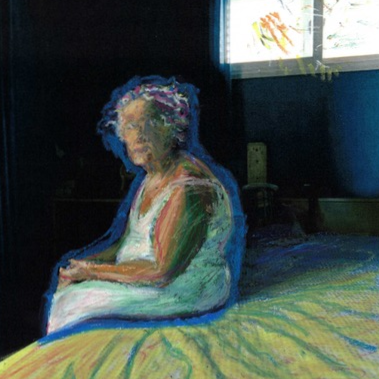
Across the hills or near the sea, in a tiny scaffolded house, or perhaps a small but charming rickety apartment, the one in the city she always dreamed of living, or the hometown she dreaded returning to–there is an old woman, comfortably accustomed to regret.
The natural cortisol shot of the morning brings her new angles of analyzing her discography of sorrows, new ways to act out the miserable one-woman drama in her mind. It’s pathetic, in a way–she is the only real actress in this play, the others have now moved away, lost contact, or are long dead. By now, too much time has passed. There is no reasonable way to say what she really wants to say anymore without seeming stuck in her own version of the past. Regret-induced arrested development. Letters from the actors, the breakout stars in her imaginary tragedy, are also jaundiced now–soon to be lost to time, thrown haphazardly in stacks of recycling by her loved ones when she inevitably runs her earthly course. No use. At least there, in heaven, or hell, or cracked coffin, mouth-full-of-dirt-and-worms, she is comforted by the thought that maybe, just maybe, it all won’t bother her so much anymore.
But she still lives, regrettably past her peers, and is damned with the displeasure of categorizing and recategorizing her various lamentations. The biggest problem with her regret is that it blatantly contradicts itself. That one true regret, the “deeper message” behind her sagas, changes depending on her mood, her hormones, the season, the strangers that uncannily look just like the actors in her head. She struggles with the burden of hating herself for what she has chosen but not knowing precisely which choice was wrong. It’s a hate for her own indecisiveness, one that has her wondering whether the pacifists have a point or if they’re simply extorted into swallowing pain for the so-called “greater good”. What is worse: the bridges she never crossed, or the ones she burned just to prove she could?
The first possible grounds for her regret are familiar: failing to express her true anger when she had the chance. How many times can she dig up the same moment and wish she had said something–what does that do to her health? What does it actually change? At the time, it even felt noble to let it pass, to construct herself as magnanimous, above the pettiness of argument, to be the so-called unbothered one. Grievance after grievance swallowed back like shots that she now, in her old decrepit state, is drunk from. Wisdom has soured this smug nobility. Biting her tongue has given her permanent wrinkles–wrinkles she doesn’t recognize in herself or the actors of the dramas in her head. Their faces and their anger and her hurt are forever suspended and static. The resentment was postponed but never dissolved.
So as time passes, she sees herself for what she is and always was: a doormat, and an aging, rotting, bitter one at that. Constantly apologizing for her own missteps but continuing to be walked over. Letting all of those conversations with herself, with the grimed walls of her shower as an audience, not be aired–stored and tucked away, permanently, in the name of diplomacy (a diplomacy that she defensively felt was never reciprocated in any case). Her right to wrath is seized from her by nature of time. Who can blame that? She never expressed it in the first place. An exhausting ritual well-known to the placating types among us–every day, or week, or once a year, she archives her hurt: she rehearses arguments in her head, forages for memories (off-hand comments, text messages, scraps of old arguments, proof of indifference–really, whatever she can find) as citations–compiles them until she can almost be sure they will be striking and hurtful and awful, justifying her relentlessness as the price for decades of untreated wounds. In a (regrettably unsatisfying) fictional court in her mind, the offenders are handed these scathing verdicts of guilt. Judges read out the carefully organized and substantiated grievances (by nature of them being rehearsed so many times) and let the offenders know exactly how, when, and why they have wronged her. And naturally, in this illusive courtroom, there is a sense of vindication–the perpetrators are tricked into introspection and grovel at her feet, begging for forgiveness from the one who is now certifiably, undeniably Justified in Her Hurt™. Decades of childish ‘schadenfreude’ shamefully and invisibly harboured can now be chipped away. These embellished actors in her mind have finally admitted that they too, are wrong.
But of course, the resentment, jealousy, and anger cannot actually be chipped away because these conversations never actually happened. And she knows her reviews are only so scathing because they can never and will never be said. Most disappointingly to her sense of self-righteousness, there’s that nagging part inside her that knows that she too, is wrong–she could’ve been a better friend, could’ve been more introspective, could’ve just accepted the agonizing lack-of-closure and moved the fuck on. But still, the old woman wondered whether diplomacy was worth the burden of feigned stoicness. To be unaffected is an act that never ends. And that is precisely the prison she has trapped herself in.
Her second source of regret is antithetical to the first: the smell of all the burned bridges in front of her. Sick of her own cowardly agreeableness, she finally said her piece–drew lines in the sand, left it all on the table, and spoke plainly. This time she didn’t bother scaffolding her hurt in meek apologies or sheepish politeness. The outbursts carried the sweetness of watching her words land, scarring someone back–it didn’t matter how and whether they were internalized, whether they prompted the great journeys of self-reflection and forgiveness she imagined in her head, or were simply met with defensiveness or silence. At least she had finally said them. Her reason for doing so was primarily selfish–she is, at last, free from her miserable one-woman-show. Poisoned the well so that the ghost arguments no longer visit her at night. A relief, if only temporarily. Because, even if the cost was expected–relationships severed beyond repair, people lost from her life forever–she can’t seem to sit well with that choice either.
Does she instead regret what she said and exactly how she said it, the thinly layered self-defensiveness bittering what, in the end, could have been constructive? Perhaps a little time would’ve shed light on factors she couldn’t then see–embers of empathy hidden by fires of frustration. Could the actors in her dreams, if not repelled forever by her blatant harshness, travel back in time to attend her dinner parties, housewarmings, her wedding(s), her funeral? The problem with “standing up for yourself” is that cathartic moments of anger often drag others right down with you.
Her judgement is also poisoned by the unsolicited wisdom dropped on her from books, novels, and anecdotes: life is too short, and it can all suddenly be taken from you. Enjoy every moment with your loved ones because it could be their last. Don’t sweat the small things. In gruesome nightmares, the apparently justified vitriol in the courtroom (but this time, acted out in real life) is the last thing she ever said to her perceived wrongdoers. Hit by a drunk driver, everybody dead on sight, or perhaps cancer, or any kind of sickness that they never told her about because she finally blew up at them and cut them off. It stains–it unbelievably muddles every good memory, every birthday, every inside joke for someone she knows that she ultimately, secretly, still loves and cares about. God, was it really that black and white? Was it really so dreadful to swallow her pride and apologize first, to keep apologizing, even if and when there is a perceived lack of introspection from the other side? Maybe Buddhists, or stoics, or New Age hippies really do have a point: people's actions really don’t have much to do with you personally. Thus, another possibility lurks: she is an unreliable narrator, actually, the entire archive of evidence is unreliable, the quotations misremembered, the motives imagined or perceived to be insidious when they simply weren't. Would it have been worth it to concede? It’s only one step to stand up for herself, but two further to losing someone forever. Furthermore, even with feelings finally said, there is only a 50% chance of the one-woman show closing its curtains forever. The argument could loop over and over again in the same fashion as things unsaid, with minor tweaks to make it more substantiated, or softer, or harsher, or kinder, or the outcomes better…
There must be another way. All the tallying of wounds–she has now missed her life twice. Once, in choosing silence or anger, and second, all the life lost to rehashing both choices in her head.
The old woman, in the scale of her melodramatic regret spectrum, acknowledges that there is probably a middle route. But my god, she thinks, is it so boring to always be the bigger person. Why must she admit her pain in a way that is palpable to someone who may not afford her the same luxury? To carefully choose words, watch out for landmines, decide whether she’d rather fully speak her mind and nuke her relationships or simply be content with carrying little pieces of things unsaid around with her everyday. And trying, as best as she can, to not let these little pieces spiral into a mountain of resentment that consumes her.
The trouble is that the middle road feels like cowardice when she is angry, and like self-betrayal when she is hurt. There is no grand jury and there is no avoiding the discomfort of confrontation like she has when she swallows her feelings. It means speaking less sharply than she really feels, offering a peace that feels counterfeit, and tolerating the gnawing knowledge that the depth of her hurt may never be fully understood. Mind-numbingly boring, yes, but she wonders if it’s perhaps the price of staying tethered to others. Small, endless, tedious sacrifices of ego.
Without a doubt, there are some situations where going scorched earth is justified, and there will be no guilt or ghosts or fictional court rooms that follow her around at night. But she can never seem to figure out exactly what those are.
And neither can I. It is my fifth time attempting to rewrite this letter to you. Everyday the tone changes based on my mood, my hormones, the season, and the strangers that uncannily look just like you. As I weigh my options, I see myself in that old woman, damned by her own indecisiveness. I’m not sure she nor I will ever send the letter anyway. Maybe the best we can do is decide which ghosts we can bear to live with.