

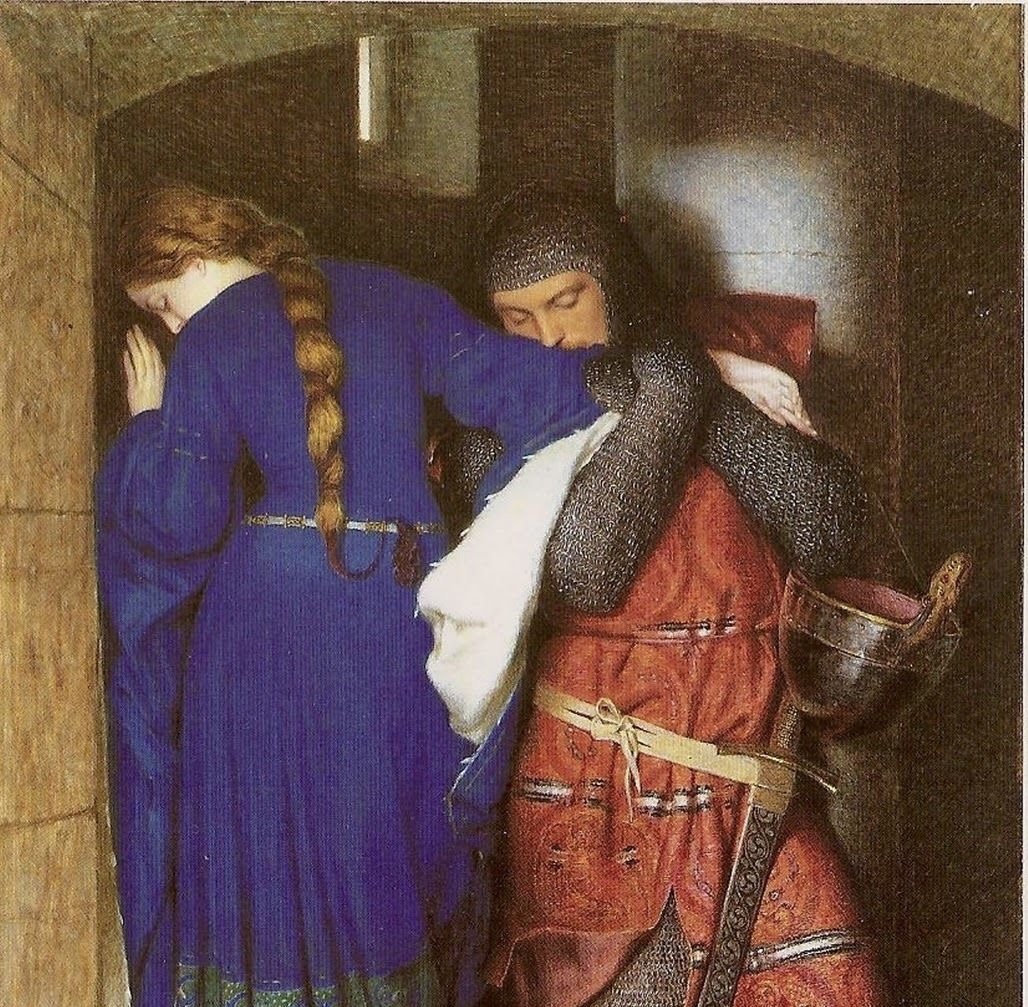
What do you know about Lancelot and Guinevere?
I’m sure it’s nothing much. The source material is shockingly sparse. Most of the Arthurian mythos is fabled and fanfiction of some secret story long since forgotten. Who knows if Lancelot and Guinevere were even having an affair in the original plot. Does it matter?
When we think about courtly love as it was during this time, overtaking media and ideologies about love as a wider premise, there are a couple of criteria it has to follow. The most important to me, particular moments notwithstanding—love as desire never to be fulfilled. You cannot have a courtly love affair that could at any point actually succeed. The backbone of the plot point, of Lancelot and Guinevere sneaking out of their beds, out of their towers, meeting on the lawn under the draping indigo sky, King Arthur clenching his jaw—the backbone is that they’re fully on terms with their doom. It just doesn’t matter to them, that they can’t actually be together. Because they’re grown ups.
But, oh. This doesn’t diminish whatever lives and dies between them. If anything, it stokes the fire, increases desperation. Guinevere can never love Arthur like she loves Lancelot, because Lancelot’s forbidden. When someone is off limits it’s like the floodgates open and they become a cancer, malignantly splitting cells in your mind until it consists only of them before you even notice. But, maybe it’s not a chicken and egg simplicity. Maybe there really is something unique about Guinevere and Lancelot’s bond, that she never felt truly seen by the king, instead finding her true companionship in his overshadowed best friend. This tragedy. This tragedy, written in blood on so many walls. What’s worse is that we’re never made to think that King Arthur doesn’t know about any of this. He’s not ignorant to the affair happening within his castle walls, probably sometimes in his own bed. He loves Guinevere, respects Lancelot (although this is where some tellings differ). It’s so, it’s so—I imagine them, the knights around the round table, scheming or whatever it was they did, and Guinevere at Arthur’s side, or perhaps across the room standing in the door frame—staring at Lancelot. And by God if he isn’t seeing right back through her. The men, shouting at each other, throwing naked chicken bones and short knives. Neither of them notice, but they also don’t notice the other returning the gaze. God. The whole thing as impenetrable as it is completely excruciating to watch.
Anyway. Another nice thing is that fairy tales exist outside of time. They’re constantly occurring. The function of them, at the beginning at least, was to see yourself reflected. Or this is what I’ve been told,
This afternoon I had to make a list of unequivocal truths, and it helped—as I sat with my knees to my chest overlooking a dense foggy train line. Last night, biking home drunk, rain spitting, hands mimicking flight, midair, instead of steering. The only thing I had the stomach for was Lana del Rey. Thinking about tennis skirts and hot pools, sunblock and caviar and salt on my stomach (or was it your stomach?), holy mass, Nascar, forgiveness, fingers all the way down my throat, infected piercings, slippery slopes, wet socks, glasses, broken glasses, wide rings and tank tops and closing the door all the way, heeled boots and glossy hair, the way I used to look at myself in the mirror when I was fifteen, the trouble I’m having now. You need to apologize, but I do too. Not in an actual way, but in a way that is a compulsion, an apology for existing within that corner, for ruining that night, etc. You need to apologize because you did something wrong. I need to because I just do. Because I’ve never been able to respond with a, ‘yeah, thanks.’ But I didn’t let you finish, I all but ran out of the room. I’ve never known about leaving well enough alone. I just haven’t.
Sunday night, pouring rain, blisters from my high heels. Lana del Rey interrupted sparingly by Coldplay. Lancelot, Guinevere, whoever else dreamed up by Don Quixote, whoever else we’ve been together—by that I mean, well, doomed.