

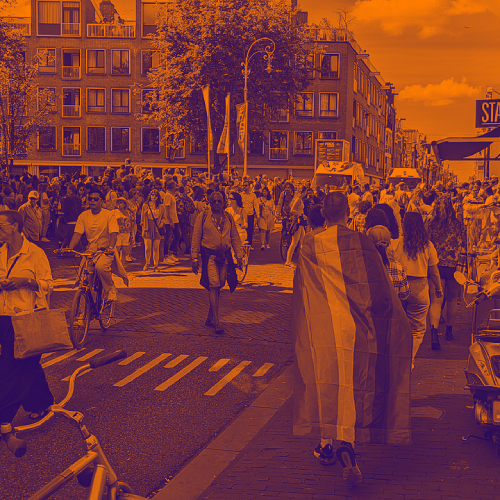
As an immigrant who has now lived in the Netherlands for nearly five years, I have learned that it is typically un-Dutch to make exceptions to the rules. But on April 1st, 2001, the city of Amsterdam decided to do just that: it opened the municipality on a Sunday.
And on that same Sunday, just after midnight, former Amsterdam mayor Job Cohen performed the first legally recognized same-sex marriages in the entire world. An unbelievable flex for the couple Gert Kasteel and Dolf Pasker, who met at a pub in Amsterdam in their 30s and later became the first ever legally married gay couple. They remain together to this day.
Unlike Kasteel and Pasker, though, who are in their sixties, I am now 25. I am precisely as old as the first legalized gay marriage. I came of age not at the beginning of queer struggle, but in a moment shaped by a victory I was too young to remember and just old enough to inherit. Of course, as an anthropologist, I should mention that queer life has never been reducible to marriage, and many cultures recognized bonds, kinship roles, gender variance, or intimate partnerships long before a modern Western state used the phrase “same-sex marriage.” And marriage is, of course, only one thread in the intricate quilt of queer experience and struggle.
Even so, the conditions of life for many in my generation are astronomically different from those of our LGBTQA+ parents and grandparents. That pride can be difficult to express in a moment like this, when so much violence and repression still persist, particularly against the trans community, and when optimism about the future can feel almost as embarrassing and out of touch as it is necessary.
I’ve been reflecting on what it means to be the first generation to grow up with a legal precedent for gay marriage. Does it matter, since most places on Earth are inarguably still hostile to gay people? What has changed in this time? Are we freer than before?
My answer is yes, though not in any neat or universal sense: globally, we are freer than before. It seems ridiculous to make a huge claim like that, since just as many countries are backsliding as there are countries making progress in queer rights. But what frees us, as a generation, was not only the first legal gay marriage being performed in Amsterdam all those years ago (though that is obviously a tremendous win). What frees us is what made those precedents travel far, far beyond the Dutch municipality where they first became law: the internet.
If Amsterdam opened one door in 2001, the internet is what made that open door visible from almost anywhere. This, really, is the subject of this short reflection on what has changed in my 25 years of existence: not just gay marriage in itself, but globalized queer possibility, and the ways the internet allowed legal and cultural precedents to travel far beyond the places where they originated. I began thinking about this recently while reflecting on how, despite growing up in entirely different cultures from many of my friends, many of us still came of age through the same shared experiences online. This was especially true among my queer friends.
Therefore, I would like to argue that unrestricted internet access, if you can get it, is actually one of the largest unintentional aids to gay liberation we have ever seen. Because no matter where you come from, who your family is, what the laws of your country are, if you are willing, you can find a queer community online. You can see that another world is possible. You can see happy gay couples being married in Amsterdam. Local repression no longer has a total monopoly on reality. And that is the biggest global difference between our generation and the ones before it.
For many young people of my generation, especially outside major cities or in hostile countries, the first real queer public was not a bar, street, or institution, but on a screen. I was cursed not to have gay aunts or uncles but blessed to have gay friends on Twitter from countries completely different from mine. They, too, celebrated with me when gay marriage became legal in my country 11 years ago, even when theirs still included the death penalty. We traded pieces of slash fiction like Pokemon cards and proudly reblogged photos of two emo girls kissing. Such was the life of the terminally online Gen Z queer: Hannah Montana-ing our existence, compartmentalizing ourselves so we could be free online, if not yet in the real world. The psychic cost of that split life deserves more attention than I can give it here in this short, ambitiously hopecore article; for now, I want to hold on to what those online worlds made imaginable, if not truly reachable.
So, we do not all live in the same reality, but we increasingly live in sight of one another. Realities of freedom and repression now coexist online. Even if you cannot yet live candidly, you may at least begin to know that another life exists, and that you have the right to be angry that you cannot have it too. You can express that anger online if you are not given that safety in your own home. In the warm glow of anonymity, there is nearly space for everyone.
It was impossible not to notice how many of my queer friends admitted to “rehearsing” their identities online through fan spaces or the consumption of queer media. It was not to my parents, or to my friends, or to anyone else that I had the first discussions wondering if I was queer: it was to my online friends. Perhaps the stakes were nominally lower—what the internet introduced was not just anonymity, but reversibility: the possibility of trying out a self in a space you could later quickly abandon. For Gen Z, who came of age with the internet, a person can begin to practice a life digitally long before they have the freedom to inhabit it physically.
Of course, this beckons questions for a later article: what kind of queerness becomes imaginable when queerness is first encountered under conditions of distance and anonymity? It may help explain why so many of my international queer friends grew up watching RuPaul’s Drag Race, even if it is no longer “their thing”; the rare queer media entertained us just as much as it built online communities of self-recognition. It also offered a shared language, culture, and set of references when we felt estranged from those around us. Drag Race’s international online success, for example, is as much a testament to American soft power and globalization as it is to the number of queer young people, pushed to the margins of their own worlds, who went online in search of something else to belong to. Even if what it offered was a limited and highly mediated view of queer life, I would still argue that such visibility was better than none at all.
For my generation, queer freedom has been radically asynchronous: unevenly distributed in law but newly simultaneous in imagination. We do not inhabit the same futures, but can at least have precedents of possibility. These precedents can be as unreachable and melancholic as they are hopeful, but they are still there. A classmate of mine from the Philippines would always reference the Netherlands as an example of what may one day be possible in their country too. And maybe that is part of what Amsterdam opened 25 years ago: not the beginning of queer life, and not the end of queer struggle, but a widening of what could be imagined, demanded, and inherited. The internet made sure the rest of us could see it too.